Solve the variation problems in Exercises 77–82. The distance that a body falls from rest is directly proportional to the square of the time of the fall. If skydivers fall 144 feet in 3 seconds, how far will they fall in 10 seconds?
Ch. 3 - Polynomial and Rational Functions

4장, 문제 78
Use synthetic division to show that 5 is a solution of x^4−4x^3−9x^2+16x+20=0. Then solve the polynomial equation.
검증된 단계별 안내1
Set up synthetic division by writing the coefficients of the polynomial . The coefficients are [1, -4, -9, 16, 20].
Since we want to test if 5 is a root, use 5 as the divisor in synthetic division. Write 5 to the left and bring down the first coefficient (1) as is.
Multiply 5 by the number just brought down (1), write the result under the next coefficient (-4), then add the column: -4 + 5 = 1. Repeat this process for each coefficient: multiply the last sum by 5, write it under the next coefficient, and add.
If the final sum (remainder) is 0, then 5 is a root of the polynomial. The numbers obtained before the remainder represent the coefficients of the quotient polynomial of degree 3.
Solve the quotient cubic polynomial obtained from synthetic division by factoring or using other methods (such as factoring by grouping, rational root theorem, or quadratic formula if it reduces to a quadratic) to find the remaining roots of the original polynomial.

비슷한 문제에 대한 검증된 영상 답변:
이 영상 해법은 위 문제에 도움이 된다고 튜터들이 추천한 것입니다.
영상 길이:
6m도움이 되었나요?
주요 개념
질문에 올바르게 답하기 위해 반드시 이해해야 하는 핵심 개념들은 다음과 같습니다.
Synthetic Division
Synthetic division is a shortcut method for dividing a polynomial by a linear factor of the form (x - c). It simplifies the division process by using only the coefficients of the polynomial, making it faster and less error-prone than long division. It also helps determine if c is a root by checking if the remainder is zero.
추천 영상:
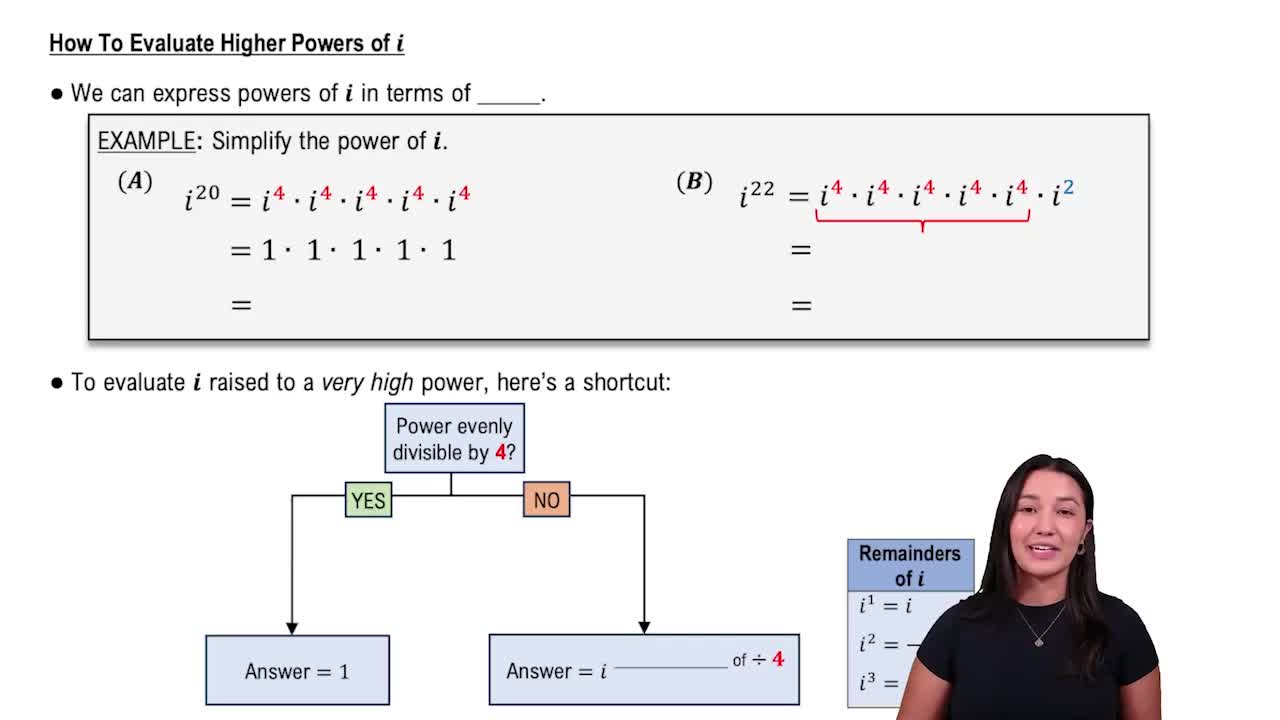
Higher Powers of i
Polynomial Roots and the Remainder Theorem
The Remainder Theorem states that when a polynomial f(x) is divided by (x - c), the remainder is f(c). If the remainder is zero, then c is a root of the polynomial, meaning (x - c) is a factor. This concept is essential for verifying solutions and factoring polynomials.
추천 영상:
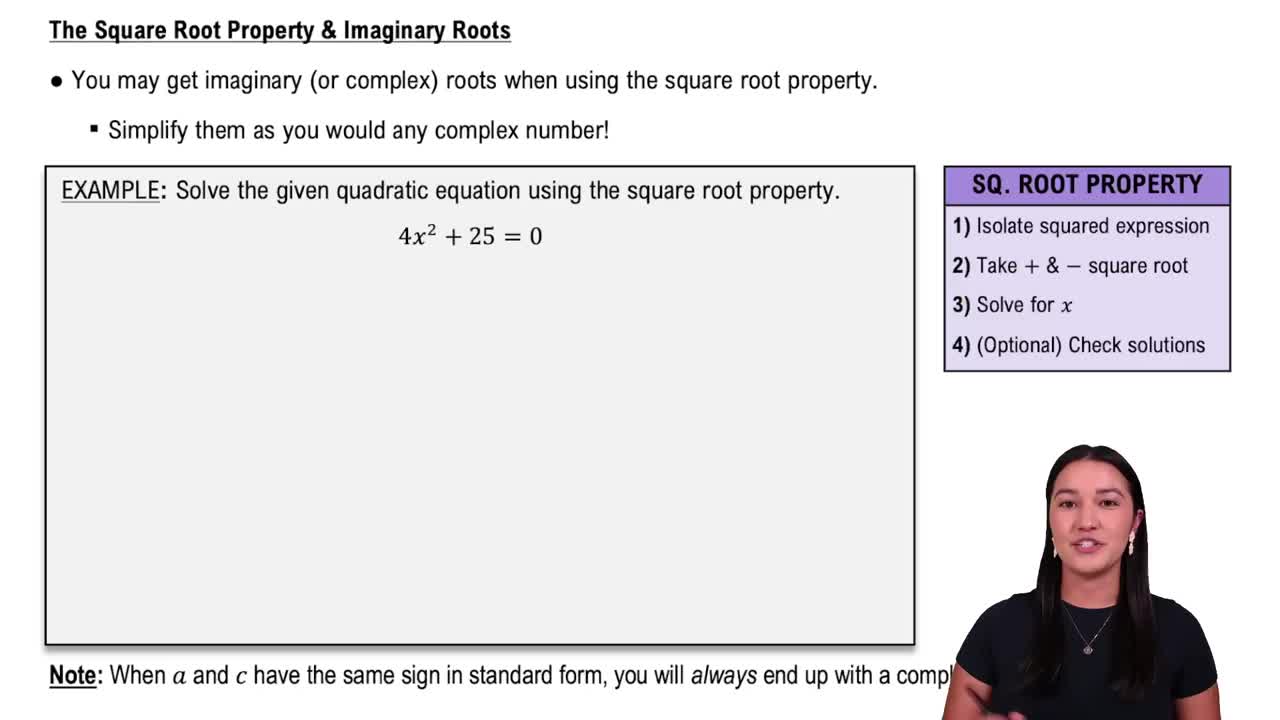
Imaginary Roots with the Square Root Property
Factoring and Solving Polynomial Equations
Once a root is found, the polynomial can be factored by dividing out the corresponding linear factor. The reduced polynomial can then be solved using factoring, the quadratic formula, or other algebraic methods. This step-by-step approach breaks down complex polynomials into simpler factors to find all solutions.
추천 영상:
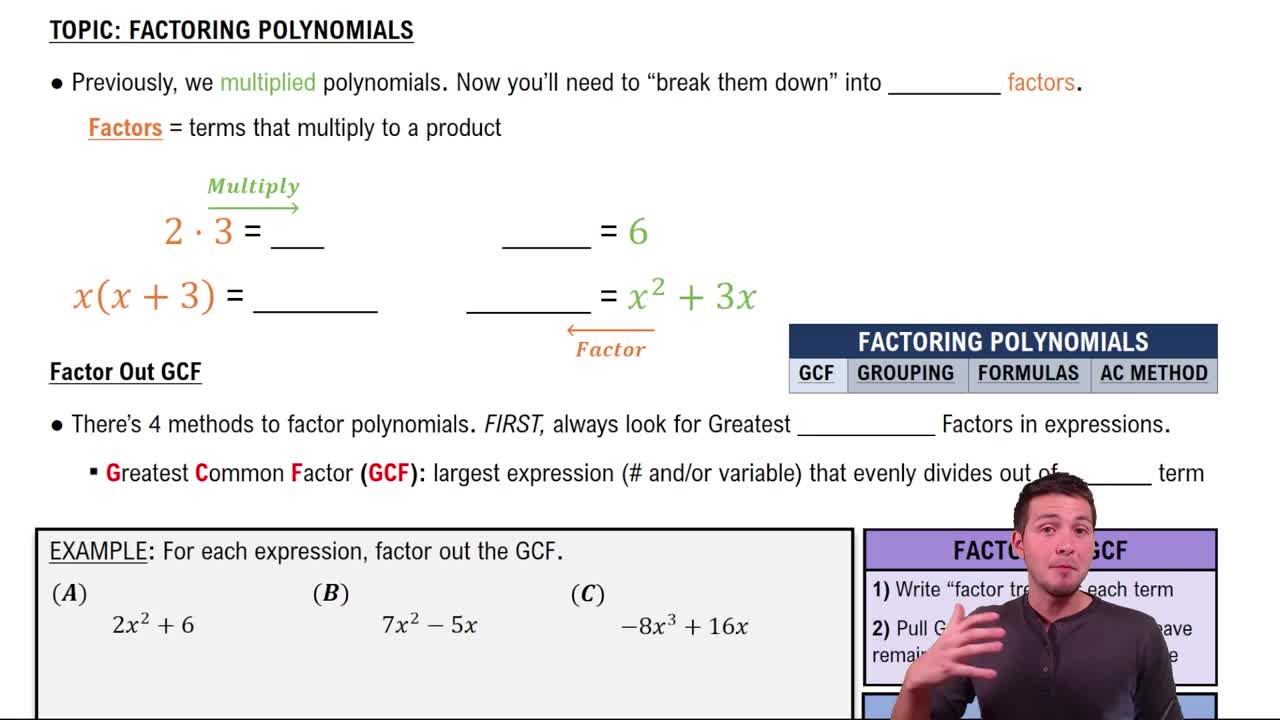
Introduction to Factoring Polynomials
관련 실천
교과서 질문
593
views
교과서 질문
In Exercises 57–80, follow the seven steps to graph each rational function. f(x)=(3x2+x−4)/(2x2−5x)
1046
views
교과서 질문
In Exercises 57–80, follow the seven steps to graph each rational function. f(x)=(x2+x−12)/(x2−4)
621
views
교과서 질문
Solve the variation problems in Exercises 77–82. The pitch of a musical tone varies inversely as its wavelength. A tone has a pitch of 660 vibrations per second and a wavelength of 1.6 feet. What is the pitch of a tone that has a wavelength of 2.4 feet?
579
views
교과서 질문
Follow the seven steps to graph each rational function. f(x)=x4/(x2+2)
1039
views
교과서 질문
When 2x2−7x+9 is divided by a polynomial, the quotient is 2x-3 and the remainder is 3. Find the polynomial.
509
views