Ch. 4 - Exponential and Logarithmic Functions
Blitzer - College Algebra 8th Edition
Blitzer8th EditionCollege AlgebraISBN: 9780136970514당신이 사용하는 게 아니라요?교과서 변경
5장, 문제 31

Begin by graphing f(x) = 2x. Then use transformations of this graph to graph the given function. Be sure to graph and give equations of the asymptotes. Use the graphs to determine each function's domain and range. If applicable, use a graphing utility to confirm your hand-drawn graphs. g(x) = −2x

검증된 단계별 안내
1
Start by graphing the base function \(f(x) = 2^{x}\). This is an exponential growth function with a horizontal asymptote at \(y = 0\). The graph passes through the point \((0, 1)\) because \(2^{0} = 1\).
Next, analyze the given function \(g(x) = -2^{x}\). Notice that this is a reflection of \(f(x)\) across the x-axis because of the negative sign in front of \$2^{x}\(. This means every y-value of \)f(x)\( is multiplied by \)-1$.
Graph the transformed function \(g(x)\) by reflecting the points of \(f(x)\) over the x-axis. For example, the point \((0, 1)\) on \(f(x)\) becomes \((0, -1)\) on \(g(x)\). The horizontal asymptote also reflects, changing from \(y = 0\) to \(y = 0\) (it remains the same line, but the graph approaches it from below now).
Write the equation of the asymptote for \(g(x)\). Since the original asymptote was \(y = 0\) and reflection does not change its position, the asymptote remains \(y = 0\).
Determine the domain and range of \(g(x)\). The domain of \$2^{x}\( is all real numbers, so the domain of \)g(x)\( is also all real numbers. The range of \)f(x)\( is \((0, \infty)\), but after reflection, the range of \)g(x)$ becomes \((-\infty, 0)\) because all output values are negative.

비슷한 문제에 대한 검증된 영상 답변:

이 영상 해법은 위 문제에 도움이 된다고 튜터들이 추천한 것입니다.
영상 길이:
10m
도움이 되었나요?

주요 개념

질문에 올바르게 답하기 위해 반드시 이해해야 하는 핵심 개념들은 다음과 같습니다.

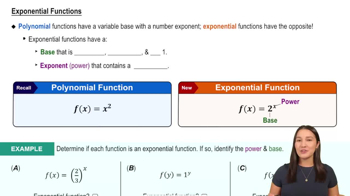
Exponential Functions

An exponential function has the form f(x) = a^x, where the base a is a positive constant not equal to 1. These functions grow or decay rapidly and have unique properties such as always being positive and having a horizontal asymptote. Understanding the basic graph of f(x) = 2^x is essential for applying transformations.
추천 영상:
6:13
Exponential Functions

Transformations of Functions

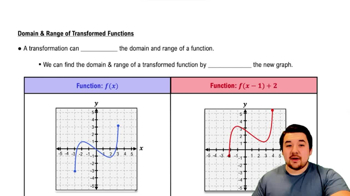
Transformations involve shifting, reflecting, stretching, or compressing the graph of a function. For g(x) = -2^x, the negative sign reflects the graph of 2^x across the x-axis. Recognizing how these changes affect the graph helps in sketching the new function and identifying changes in domain, range, and asymptotes.
추천 영상:
4:22
Domain & Range of Transformed Functions

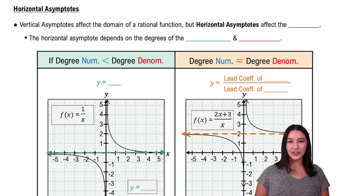
Asymptotes, Domain, and Range

An asymptote is a line that the graph approaches but never touches. For exponential functions like 2^x, the horizontal asymptote is y = 0. Understanding asymptotes helps determine the domain (all real numbers) and range (values the function can take), which may change after transformations such as reflections.
추천 영상:
4:48
Determining Horizontal Asymptotes