Begin by graphing f(x) = 2x. Then use transformations of this graph to graph the given function. Be sure to graph and give equations of the asymptotes. Use the graphs to determine each function's domain and range. If applicable, use a graphing utility to confirm your hand-drawn graphs. g(x) = 2.2x

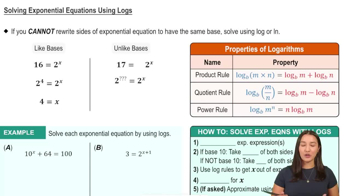
Solve each exponential equation in Exercises 23–48. Express the solution set in terms of natural logarithms or common logarithms. Then use a calculator to obtain a decimal approximation, correct to two decimal places, for the solution. 3e5x=1977
검증된 단계별 안내
비슷한 문제에 대한 검증된 영상 답변:
주요 개념
Exponential Equations
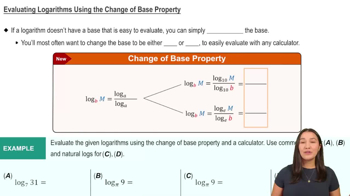
Logarithms and Their Properties
Using Calculators for Approximations
In Exercises 32–35, the graph of a logarithmic function is given. Select the function for each graph from the following options: f(x) = log x, g(x) = log(-x), h(x) = log(2-x), r(x)= 1+log(2-x)
Evaluate each expression without using a calculator. log2 (1/√2)
Begin by graphing f(x) = 2x. Then use transformations of this graph to graph the given function. Be sure to graph and give equations of the asymptotes. Use the graphs to determine each function's domain and range. If applicable, use a graphing utility to confirm your hand-drawn graphs. g(x) = −2x
Use properties of logarithms to expand each logarithmic expression as much as possible. Where possible, evaluate logarithmic expressions without using a calculator. log ∛(x/y)
Evaluate each expression without using a calculator. log64 8
