Ch. 4 - Exponential and Logarithmic Functions
Blitzer - College Algebra 8th Edition
Blitzer8th EditionCollege AlgebraISBN: 9780136970514당신이 사용하는 게 아니라요?교과서 변경
5장, 문제 33

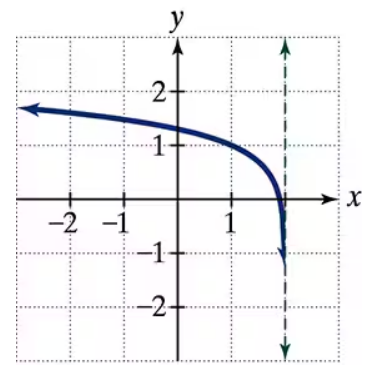
In Exercises 32–35, the graph of a logarithmic function is given. Select the function for each graph from the following options: f(x) = log x, g(x) = log(-x), h(x) = log(2-x), r(x)= 1+log(2-x)

검증된 단계별 안내
1
Identify the domain of each logarithmic function option, since the domain determines where the function is defined and affects the graph's shape. For example, for \(f(x) = \log x\), the domain is \(x > 0\); for \(g(x) = \log(-x)\), the domain is \(x < 0\); for \(h(x) = \log(2 - x)\), the domain is \(x < 2\); and for \(r(x) = 1 + \log(2 - x)\), the domain is also \(x < 2\).
Examine the graph's x-values where the function exists. If the graph only shows values for \(x > 0\), it likely corresponds to \(f(x) = \log x\). If the graph exists only for negative \(x\) values, it could be \(g(x) = \log(-x)\). If the graph exists for \(x < 2\), it could be either \(h(x)\) or \(r(x)\).
Look for vertical shifts in the graph. The function \(r(x) = 1 + \log(2 - x)\) is a vertical shift of \(h(x) = \log(2 - x)\) by 1 unit upwards. If the graph appears shifted up compared to the standard logarithmic shape, it suggests \(r(x)\).
Check the behavior near the vertical asymptote. For \(f(x) = \log x\), the vertical asymptote is at \(x = 0\); for \(h(x)\) and \(r(x)\), it is at \(x = 2\). Confirm where the graph approaches negative infinity to identify the asymptote.
Match the graph's shape and domain with the function options based on the above observations to select the correct function for each graph.

비슷한 문제에 대한 검증된 영상 답변:

이 영상 해법은 위 문제에 도움이 된다고 튜터들이 추천한 것입니다.
영상 길이:
4m
도움이 되었나요?

주요 개념

질문에 올바르게 답하기 위해 반드시 이해해야 하는 핵심 개념들은 다음과 같습니다.

Logarithmic Functions and Their Domains

A logarithmic function is defined only for positive arguments inside the log. For example, f(x) = log(x) requires x > 0. Understanding the domain restrictions helps identify which function matches a given graph, as the graph exists only where the input to the log is positive.
추천 영상:
5:26
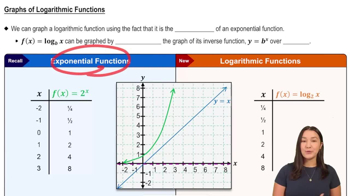
Graphs of Logarithmic Functions

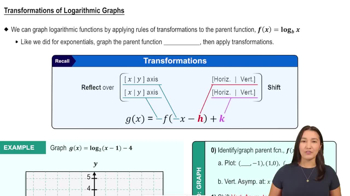
Transformations of Logarithmic Functions

Logarithmic functions can be shifted or reflected by modifying their input or output. For instance, g(x) = log(-x) reflects the graph of log(x) across the y-axis, while h(x) = log(2 - x) shifts and reflects it horizontally. The function r(x) = 1 + log(2 - x) also shifts the graph vertically by 1 unit.
추천 영상:
4:37
Transformations of Logarithmic Graphs

Interpreting Graphs to Identify Functions

Analyzing key features of the graph, such as domain, intercepts, and asymptotes, helps match it to the correct logarithmic function. For example, vertical asymptotes occur where the argument of the log is zero, and shifts in the graph indicate transformations applied to the basic log function.
추천 영상:
05:01
Identifying Intervals of Unknown Behavior
관련 실천