Ch. 4 - Exponential and Logarithmic Functions
Blitzer - College Algebra 8th Edition
Blitzer8th EditionCollege AlgebraISBN: 9780136970514당신이 사용하는 게 아니라요?교과서 변경
5장, 문제 71

In Exercises 71–78, use common logarithms or natural logarithms and a calculator to evaluate to four decimal places. log5 13

검증된 단계별 안내
1
Recognize that the logarithm given is \( \log_5 13 \), which means the logarithm of 13 with base 5.
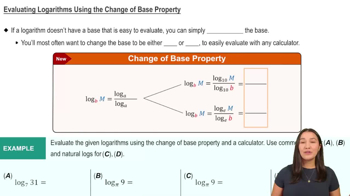
Recall the change of base formula for logarithms: \( \log_a b = \frac{\log_c b}{\log_c a} \), where \( c \) can be any positive number (commonly 10 or \( e \)).
Apply the change of base formula using common logarithms (base 10): \( \log_5 13 = \frac{\log_{10} 13}{\log_{10} 5} \).
Use a calculator to find the values of \( \log_{10} 13 \) and \( \log_{10} 5 \) separately, making sure to keep enough decimal places for accuracy.
Divide the value of \( \log_{10} 13 \) by \( \log_{10} 5 \) to get \( \log_5 13 \), then round your answer to four decimal places.

비슷한 문제에 대한 검증된 영상 답변:

이 영상 해법은 위 문제에 도움이 된다고 튜터들이 추천한 것입니다.
영상 길이:
3m
도움이 되었나요?

주요 개념

질문에 올바르게 답하기 위해 반드시 이해해야 하는 핵심 개념들은 다음과 같습니다.

Logarithms and Their Bases

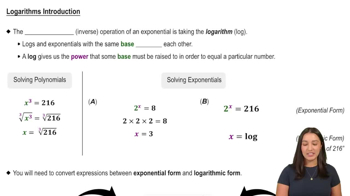
A logarithm answers the question: to what power must the base be raised to produce a given number? In this problem, log base 5 of 13 means finding the exponent x such that 5^x = 13. Understanding the relationship between exponents and logarithms is fundamental.
추천 영상:
7:30
Logarithms Introduction

Change of Base Formula

The change of base formula allows you to evaluate logarithms with any base using common (base 10) or natural (base e) logarithms: log_b(a) = log(a) / log(b). This is essential when calculators only provide log or ln functions, enabling calculation of log base 5 of 13.
추천 영상:
5:36
Change of Base Property

Using a Calculator for Logarithms

Calculators typically have buttons for common logarithms (log base 10) and natural logarithms (ln). To find log base 5 of 13, use the change of base formula with either log or ln, then compute the values and divide, rounding the result to four decimal places as required.
추천 영상:
7:30
Logarithms Introduction
관련 실천
교과서 질문

Solve each logarithmic equation in Exercises 49–92. Be sure to reject any value of x that is not in the domain of the original logarithmic expressions. Give the exact answer. Then, where necessary, use a calculator to obtain a decimal approximation, correct to two decimal places, for the solution. log2(x+2)−log2(x−5)=3

839
views
교과서 질문

Solve each logarithmic equation in Exercises 49–92. Be sure to reject any value of x that is not in the domain of the original logarithmic expressions. Give the exact answer. Then, where necessary, use a calculator to obtain a decimal approximation, correct to two decimal places, for the solution. 2 log3(x+4)=log3 9 + 2

706
views
교과서 질문

Find the domain of each logarithmic function. f(x) = log5(x+4)

1245
views
교과서 질문

Solve each logarithmic equation in Exercises 49–92. Be sure to reject any value of x that is not in the domain of the original logarithmic expressions. Give the exact answer. Then, where necessary, use a calculator to obtain a decimal approximation, correct to two decimal places, for the solution. log3(x+6)+log3(x+4)=1

1102
views
교과서 질문

In Exercises 71–78, use common logarithms or natural logarithms and a calculator to evaluate to four decimal places. log14 87.5

803
views
교과서 질문

Use properties of logarithms to condense each logarithmic expression. Write the expression as a single logarithm whose coefficient is 1. Where possible, evaluate logarithmic expressions without using a calculator. logx+log(x21)log7log(x+1)\(\log\) x + \(\log\)(x^2 - 1) - \(\log\) 7 - \(\log\)(x + 1)

1275
views