Ch. 4 - Exponential and Logarithmic Functions
Blitzer - College Algebra 8th Edition
Blitzer8th EditionCollege AlgebraISBN: 9780136970514당신이 사용하는 게 아니라요?교과서 변경
5장, 문제 71

Solve each logarithmic equation in Exercises 49–92. Be sure to reject any value of x that is not in the domain of the original logarithmic expressions. Give the exact answer. Then, where necessary, use a calculator to obtain a decimal approximation, correct to two decimal places, for the solution. log2(x+2)−log2(x−5)=3

검증된 단계별 안내
1
Recall the logarithmic property that states \( \log_b A - \log_b B = \log_b \left( \frac{A}{B} \right) \). Apply this to the equation \( \log_2 (x+2) - \log_2 (x-5) = 3 \) to combine the logs into one: \( \log_2 \left( \frac{x+2}{x-5} \right) = 3 \).
Rewrite the logarithmic equation in its equivalent exponential form. Since \( \log_b y = x \) means \( y = b^x \), rewrite \( \log_2 \left( \frac{x+2}{x-5} \right) = 3 \) as \( \frac{x+2}{x-5} = 2^3 \).
Simplify the right side of the equation: \( 2^3 = 8 \), so the equation becomes \( \frac{x+2}{x-5} = 8 \).
Solve the resulting rational equation by cross-multiplying: \( x + 2 = 8(x - 5) \). Then, distribute and collect like terms to isolate \( x \).
Check the domain restrictions for the original logarithmic expressions: \( x + 2 > 0 \) and \( x - 5 > 0 \), which means \( x > -2 \) and \( x > 5 \). Only values of \( x \) greater than 5 are valid. Verify that your solution satisfies this domain before finalizing your answer.

비슷한 문제에 대한 검증된 영상 답변:

이 영상 해법은 위 문제에 도움이 된다고 튜터들이 추천한 것입니다.
영상 길이:
4m
도움이 되었나요?

주요 개념

질문에 올바르게 답하기 위해 반드시 이해해야 하는 핵심 개념들은 다음과 같습니다.

Properties of Logarithms

Understanding the properties of logarithms, especially the subtraction rule log_b(A) - log_b(B) = log_b(A/B), is essential for simplifying and solving logarithmic equations. This allows combining multiple logarithmic terms into a single logarithm, making the equation easier to solve.
추천 영상:
5:36
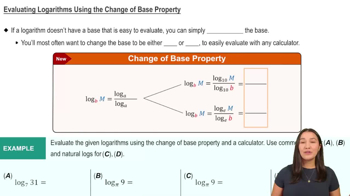
Change of Base Property

Domain of Logarithmic Functions

The domain of a logarithmic function log_b(x) includes only positive values of x. When solving logarithmic equations, it is crucial to identify and exclude any solutions that make the arguments of the logarithms non-positive, ensuring the solution is valid within the function's domain.
추천 영상:
5:26
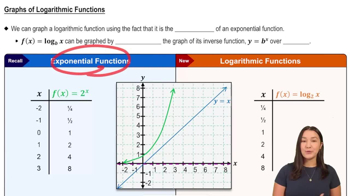
Graphs of Logarithmic Functions

Converting Logarithmic Equations to Exponential Form

To solve logarithmic equations, converting the equation from logarithmic form to exponential form is often necessary. For example, log_b(A) = C can be rewritten as A = b^C, which allows solving for the variable algebraically.
추천 영상:
5:02
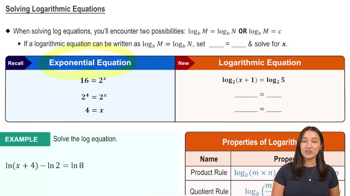
Solving Logarithmic Equations
관련 실천
교과서 질문

In Exercises 71–78, use common logarithms or natural logarithms and a calculator to evaluate to four decimal places. log5 13

1563
views
교과서 질문

Solve each logarithmic equation in Exercises 49–92. Be sure to reject any value of x that is not in the domain of the original logarithmic expressions. Give the exact answer. Then, where necessary, use a calculator to obtain a decimal approximation, correct to two decimal places, for the solution. 2 log3(x+4)=log3 9 + 2

706
views
교과서 질문

Solve each logarithmic equation in Exercises 49–92. Be sure to reject any value of x that is not in the domain of the original logarithmic expressions. Give the exact answer. Then, where necessary, use a calculator to obtain a decimal approximation, correct to two decimal places, for the solution. log3(x+6)+log3(x+4)=1

1102
views
교과서 질문

In Exercises 71–78, use common logarithms or natural logarithms and a calculator to evaluate to four decimal places. log14 87.5

803
views
교과서 질문

Use properties of logarithms to condense each logarithmic expression. Write the expression as a single logarithm whose coefficient is 1. Where possible, evaluate logarithmic expressions without using a calculator. logx+log(x21)log7log(x+1)\(\log\) x + \(\log\)(x^2 - 1) - \(\log\) 7 - \(\log\)(x + 1)

1275
views
교과서 질문

The figure shows the graph of f(x) = ln x. In Exercises 65–74, use transformations of this graph to graph each function. Graph and give equations of the asymptotes. Use the graphs to determine each function's domain and range. g(x) = 2 ln x

554
views