Solve each logarithmic equation in Exercises 49–92. Be sure to reject any value of x that is not in the domain of the original logarithmic expressions. Give the exact answer. Then, where necessary, use a calculator to obtain a decimal approximation, correct to two decimal places, for the solution. log(x+4)=log x+log 4
Ch. 4 - Exponential and Logarithmic Functions

5장, 문제 79
In Exercises 74–79, solve each logarithmic equation. log4 (2x+1) = log4 (x-3) + log4 (x+5)
검증된 단계별 안내1
Recall the logarithmic property that allows you to combine the sum of logarithms with the same base: \(\log_b A + \log_b B = \log_b (A \times B)\). Apply this to the right side of the equation to combine the two logarithms into one.
Rewrite the equation using the property: \(\log_4 (2x + 1) = \log_4 ((x - 3)(x + 5))\).
Since the logarithms on both sides have the same base and are equal, set their arguments equal to each other: \(2x + 1 = (x - 3)(x + 5)\).
Expand the right side by multiplying the binomials: \((x - 3)(x + 5) = x^2 + 5x - 3x - 15 = x^2 + 2x - 15\).
Set up the equation \(2x + 1 = x^2 + 2x - 15\) and then rearrange all terms to one side to form a quadratic equation: \(0 = x^2 + 2x - 15 - 2x - 1\), which simplifies to \(0 = x^2 - 16\). From here, solve for \(x\).

비슷한 문제에 대한 검증된 영상 답변:
이 영상 해법은 위 문제에 도움이 된다고 튜터들이 추천한 것입니다.
영상 길이:
4m도움이 되었나요?
주요 개념
질문에 올바르게 답하기 위해 반드시 이해해야 하는 핵심 개념들은 다음과 같습니다.
Properties of Logarithms
Understanding the properties of logarithms, such as the product, quotient, and power rules, is essential. In this problem, the product rule allows combining the sum of logarithms on one side into a single logarithm, simplifying the equation for easier solving.
추천 영상:
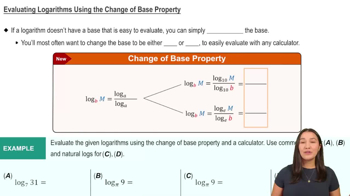
Change of Base Property
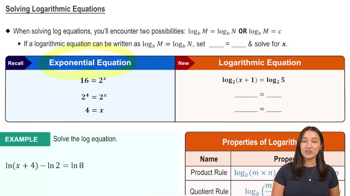
Solving Logarithmic Equations
Solving logarithmic equations often involves rewriting the equation using logarithm properties and then converting it to an exponential form or equating the arguments of the logarithms when the bases are the same. This approach helps isolate the variable and find its value.
추천 영상:
Solving Logarithmic Equations
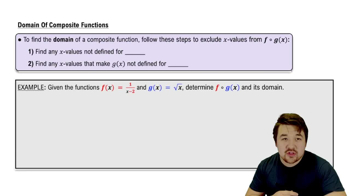
Domain Restrictions of Logarithmic Functions
Logarithmic functions are only defined for positive arguments. When solving equations, it is crucial to check that the solutions satisfy the domain restrictions (arguments inside the logs must be greater than zero) to ensure valid answers.
추천 영상:
Domain Restrictions of Composed Functions
관련 실천
교과서 질문
750
views
교과서 질문
Find the domain of each logarithmic function. f(x) = ln (x-2)²
795
views
교과서 질문
Use a graphing utility and the change-of-base property to graph each function. y = log3 x
798
views
교과서 질문
Solve each logarithmic equation in Exercises 49–92. Be sure to reject any value of x that is not in the domain of the original logarithmic expressions. Give the exact answer. Then, where necessary, use a calculator to obtain a decimal approximation, correct to two decimal places, for the solution. log(3x−3)=log(x+1)+log 4
719
views
교과서 질문
Use common logarithms or natural logarithms and a calculator to evaluate to four decimal places. logπ 63
829
views
교과서 질문
Find the domain of each logarithmic function. f(x) = log (2 - x)
1117
views