Ch. 4 - Exponential and Logarithmic Functions
Blitzer - College Algebra 8th Edition
Blitzer8th EditionCollege AlgebraISBN: 9780136970514당신이 사용하는 게 아니라요?교과서 변경
5장, 문제 79

Solve each logarithmic equation in Exercises 49–92. Be sure to reject any value of x that is not in the domain of the original logarithmic expressions. Give the exact answer. Then, where necessary, use a calculator to obtain a decimal approximation, correct to two decimal places, for the solution. log(3x−3)=log(x+1)+log 4

검증된 단계별 안내
1
Start with the given equation: \(\log(3x - 3) = \log(x + 1) + \log 4\).
Use the logarithm property that states \(\log a + \log b = \log(ab)\) to combine the right side: \(\log(3x - 3) = \log(4(x + 1))\).
Since the logarithms on both sides have the same base and are equal, set their arguments equal: \(3x - 3 = 4(x + 1)\).
Solve the resulting linear equation for \(x\): expand the right side to get \(3x - 3 = 4x + 4\), then isolate \(x\) by moving terms appropriately.
Check the solution(s) by substituting back into the original logarithmic expressions to ensure the arguments are positive, because the domain of \(\log\) requires the input to be greater than zero.

비슷한 문제에 대한 검증된 영상 답변:

이 영상 해법은 위 문제에 도움이 된다고 튜터들이 추천한 것입니다.
영상 길이:
4m
도움이 되었나요?

주요 개념

질문에 올바르게 답하기 위해 반드시 이해해야 하는 핵심 개념들은 다음과 같습니다.

Properties of Logarithms

Understanding the properties of logarithms, such as the product rule log(a) + log(b) = log(ab), is essential for combining or simplifying logarithmic expressions. This allows you to rewrite the equation in a more manageable form to isolate the variable.
추천 영상:
5:36
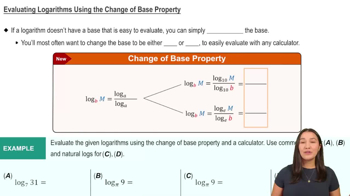
Change of Base Property

Domain of Logarithmic Functions

The domain of a logarithmic function includes only positive arguments because the logarithm of zero or a negative number is undefined. Identifying and restricting the domain ensures that any solutions found are valid within the original equation.
추천 영상:
5:26
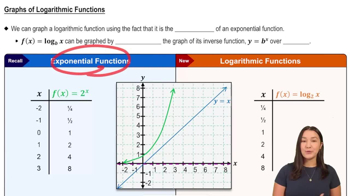
Graphs of Logarithmic Functions

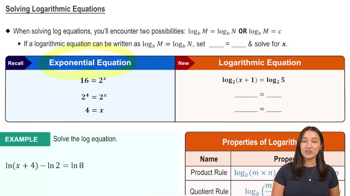
Solving Logarithmic Equations

Solving logarithmic equations often involves rewriting the equation in exponential form or using properties of logarithms to isolate the variable. After simplification, you solve the resulting algebraic equation and verify solutions against the domain restrictions.
추천 영상:
5:02
Solving Logarithmic Equations