Ch. 8 - Sequences, Induction, and Probability
Blitzer - College Algebra 8th Edition
Blitzer8th EditionCollege AlgebraISBN: 9780136970514당신이 사용하는 게 아니라요?교과서 변경
9장, 문제 62

Evaluate the given binomial coefficient 11 8

검증된 단계별 안내
1
Step 1: Recall the formula for a binomial coefficient, which is given by \( \binom{n}{k} = \frac{n!}{k!(n-k)!} \), where \( n \) is the total number of items, \( k \) is the number of items chosen, and \( ! \) represents factorial.
Step 2: Identify \( n \) and \( k \) from the problem. Here, \( n = 11 \) and \( k = 8 \). Substitute these values into the formula: \( \binom{11}{8} = \frac{11!}{8!(11-8)!} \).
Step 3: Simplify the denominator \( (11-8)! \). Since \( 11-8 = 3 \), the denominator becomes \( 8! \cdot 3! \). The formula now looks like \( \binom{11}{8} = \frac{11!}{8! \cdot 3!} \).
Step 4: Expand \( 11! \) in terms of \( 8! \) to simplify the calculation. Recall that \( 11! = 11 \cdot 10 \cdot 9 \cdot 8! \). Substitute this into the formula: \( \binom{11}{8} = \frac{11 \cdot 10 \cdot 9 \cdot 8!}{8! \cdot 3!} \).
Step 5: Cancel \( 8! \) from the numerator and denominator, leaving \( \binom{11}{8} = \frac{11 \cdot 10 \cdot 9}{3!} \). Finally, recall that \( 3! = 3 \cdot 2 \cdot 1 \), so the denominator becomes 6. The result can now be calculated by dividing \( 11 \cdot 10 \cdot 9 \) by 6.

비슷한 문제에 대한 검증된 영상 답변:

이 영상 해법은 위 문제에 도움이 된다고 튜터들이 추천한 것입니다.
영상 길이:
2m
도움이 되었나요?

주요 개념

질문에 올바르게 답하기 위해 반드시 이해해야 하는 핵심 개념들은 다음과 같습니다.

Binomial Coefficient

A binomial coefficient, denoted as C(n, k) or 'n choose k', represents the number of ways to choose k elements from a set of n elements without regard to the order of selection. It is calculated using the formula C(n, k) = n! / (k!(n-k)!), where '!' denotes factorial, the product of all positive integers up to that number.
추천 영상:
03:41
Special Products - Cube Formulas

Factorial

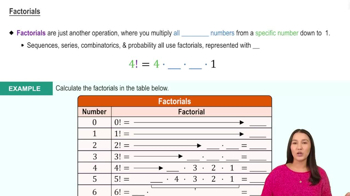
The factorial of a non-negative integer n, denoted as n!, is the product of all positive integers from 1 to n. For example, 5! = 5 × 4 × 3 × 2 × 1 = 120. Factorials are fundamental in combinatorics, particularly in calculating binomial coefficients, as they provide the necessary counts of arrangements.
추천 영상:
5:22
Factorials

Combinatorial Interpretation

The combinatorial interpretation of binomial coefficients provides a way to understand their significance in counting problems. For instance, C(11, 8) can be interpreted as the number of ways to select 8 items from a total of 11, which is equivalent to selecting 3 items to leave out, illustrating the symmetry C(n, k) = C(n, n-k).
추천 영상:
4:04
Fundamental Counting Principle