Use mathematical induction to prove that the statement is true for every positive integer n. 1 + 4 + 4^2 + ... + 4^(n-1) = ((4^n)-1)/3
Ch. 8 - Sequences, Induction, and Probability

9장, 문제 59
In Exercises 55–60, express each sum using summation notation. Use a lower limit of summation of your choice and k for the index of summation.
검증된 단계별 안내1
Identify the pattern in the sum: the terms are a, (a + d), (a + 2d), ..., (a + nd), which shows an arithmetic sequence where each term increases by d.
Choose the index of summation as k, starting from 0 to n, because the first term corresponds to k = 0 and the last term corresponds to k = n.
Express the general term of the sequence using k: the k-th term is .
Write the summation notation by summing the general term from k = 0 to k = n: .
This summation notation compactly represents the entire sum .

비슷한 문제에 대한 검증된 영상 답변:
이 영상 해법은 위 문제에 도움이 된다고 튜터들이 추천한 것입니다.
영상 길이:
3m도움이 되었나요?
주요 개념
질문에 올바르게 답하기 위해 반드시 이해해야 하는 핵심 개념들은 다음과 같습니다.
Arithmetic Sequence
An arithmetic sequence is a list of numbers where each term after the first is found by adding a constant difference, d, to the previous term. In the given sum, the terms follow this pattern: a, a+d, a+2d, ..., a+nd, which is the foundation for expressing the sum in summation notation.
추천 영상:
가이드 코스
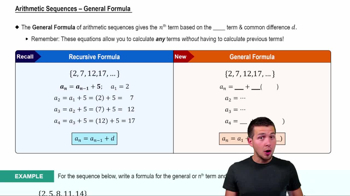
Arithmetic Sequences - General Formula
Summation Notation
Summation notation uses the sigma symbol (∑) to represent the sum of a sequence of terms. It includes an index of summation, a lower limit, and an upper limit, allowing a compact expression of long sums like the arithmetic sequence given in the problem.
추천 영상:
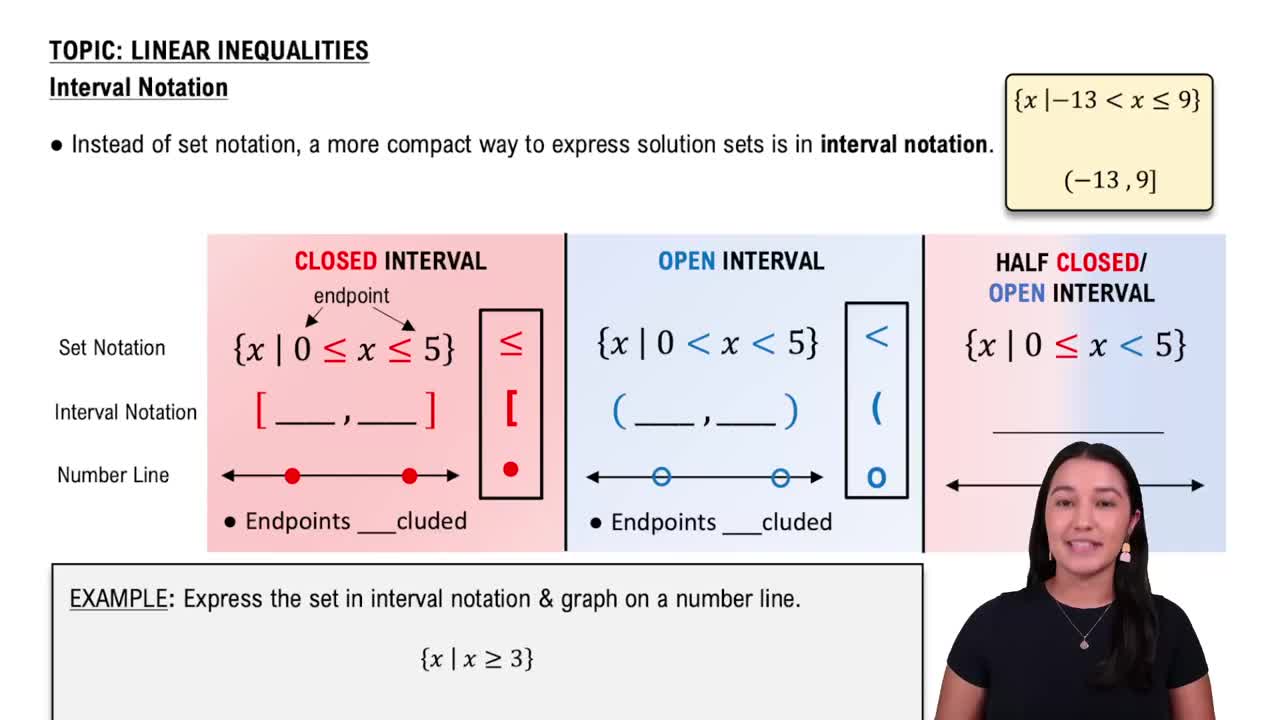
Interval Notation
Index of Summation and Limits
The index of summation, often denoted by k, is a variable that represents each term's position in the sequence. The lower and upper limits define the range of terms to be summed. Choosing appropriate limits and expressing each term in terms of k is essential to correctly write the sum in summation notation.
추천 영상:
가이드 코스
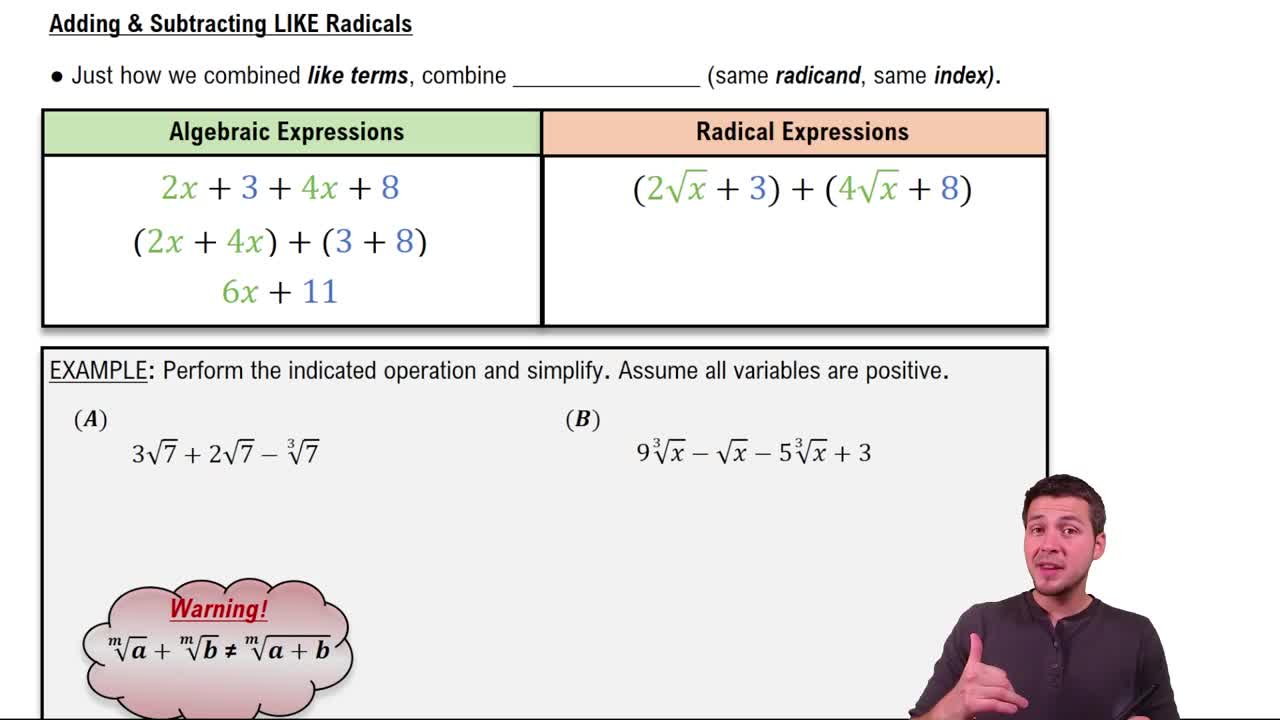
Adding & Subtracting Like Radicals
관련 실천
교과서 질문
802
views
교과서 질문
Let {an} = - 5, 10, - 20, 40, ..., {bn} = 10, - 5, - 20, - 35, ..., {cn} = - 2, 1, - 1/2, 1/4 Find the difference between the sum of the first 10 terms of {an} and the sum of the first 10 terms of {bn}.
791
views
교과서 질문
In Exercises 61–68, use the graphs of and to find each indicated sum.
868
views
교과서 질문
Evaluate the given binomial coefficient 11 8
702
views
교과서 질문
Express each sum using summation notation. Use a lower limit of summation of your choice and k for the index of summation. a+ar+ar2+⋯+ ar12
864
views
교과서 질문
Let {an} = - 5, 10, - 20, 40, ..., {bn} = 10, - 5, - 20, - 35, ..., {cn} = - 2, 1, - 1/2, 1/4 Find the difference between the sum of the first 6 terms of {an} and the sum of the infinite seris containing all the terms of {cn}.
32
views