Ch. 8 - Sequences, Induction, and Probability
Blitzer - College Algebra 8th Edition
Blitzer8th EditionCollege AlgebraISBN: 9780136970514당신이 사용하는 게 아니라요?교과서 변경
9장, 문제 39

Find 1+2+3+4+...+ 100, the sum of the first 100 natural numbers.

검증된 단계별 안내
1
Recognize that the problem asks for the sum of the first 100 natural numbers, which is an arithmetic series where the first term \(a_1 = 1\) and the last term \(a_n = 100\).
Recall the formula for the sum of the first \(n\) natural numbers: \(S_n = \frac{n(n+1)}{2}\), where \(n\) is the number of terms.
Identify that in this problem, \(n = 100\) because we are summing from 1 to 100.
Substitute \(n = 100\) into the formula to set up the expression: \(S_{100} = \frac{100(100+1)}{2}\).
Simplify the expression step-by-step to find the sum, but do not calculate the final numeric value as per instructions.

비슷한 문제에 대한 검증된 영상 답변:

이 영상 해법은 위 문제에 도움이 된다고 튜터들이 추천한 것입니다.
영상 길이:
3m
도움이 되었나요?

주요 개념

질문에 올바르게 답하기 위해 반드시 이해해야 하는 핵심 개념들은 다음과 같습니다.

Arithmetic Series

An arithmetic series is the sum of the terms of an arithmetic sequence, where each term increases by a constant difference. In this problem, the numbers 1, 2, 3, ..., 100 form an arithmetic sequence with a common difference of 1.
추천 영상:
5:17
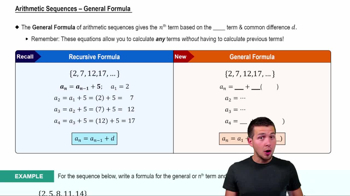
Arithmetic Sequences - General Formula

Formula for the Sum of the First n Natural Numbers

The sum of the first n natural numbers can be found using the formula S = n(n + 1)/2. This formula provides a quick way to calculate the sum without adding each number individually.
추천 영상:
06:36
Solving Quadratic Equations Using The Quadratic Formula

Natural Numbers

Natural numbers are the set of positive integers starting from 1 (1, 2, 3, ...). Understanding that the problem involves the first 100 natural numbers helps identify the sequence and apply the appropriate summation formula.
추천 영상:
2:51
The Natural Log