Ch. 8 - Sequences, Induction, and Probability
Blitzer - College Algebra 8th Edition
Blitzer8th EditionCollege AlgebraISBN: 9780136970514당신이 사용하는 게 아니라요?교과서 변경
9장, 문제 39

Find each indicated sum. i=04(1)ii!\(\sum\)_{i=0}^{4} \(\frac{(-1)^i}{i!}\)

검증된 단계별 안내
1
Identify the sum notation and the terms involved. The sum is given by \(\sum_{i=0}^{4} \frac{(-1)^i}{i!}\), which means you will add terms from \(i=0\) to \(i=4\) of the expression \(\frac{(-1)^i}{i!}\).
Recall the definition of factorial: for any non-negative integer \(n\), \(n! = n \times (n-1) \times \cdots \times 1\), with the special case \(0! = 1\).
Write out each term explicitly for \(i=0, 1, 2, 3, 4\): - When \(i=0\), the term is \(\frac{(-1)^0}{0!}\) - When \(i=1\), the term is \(\frac{(-1)^1}{1!}\) - When \(i=2\), the term is \(\frac{(-1)^2}{2!}\) - When \(i=3\), the term is \(\frac{(-1)^3}{3!}\) - When \(i=4\), the term is \(\frac{(-1)^4}{4!}\)
Calculate each factorial value and the corresponding power of \(-1\) for each term, then write each term as a simplified fraction.
Add all the simplified terms together to find the sum \(\sum_{i=0}^{4} \frac{(-1)^i}{i!}\).

비슷한 문제에 대한 검증된 영상 답변:

이 영상 해법은 위 문제에 도움이 된다고 튜터들이 추천한 것입니다.
영상 길이:
4m
도움이 되었나요?

주요 개념

질문에 올바르게 답하기 위해 반드시 이해해야 하는 핵심 개념들은 다음과 같습니다.

Summation Notation (Sigma Notation)

Summation notation uses the Greek letter sigma (Σ) to represent the sum of a sequence of terms. The expression specifies the index of summation, its starting and ending values, and the general term to be summed. Understanding how to interpret and evaluate these sums is essential for solving problems involving series.
추천 영상:
05:18
Interval Notation

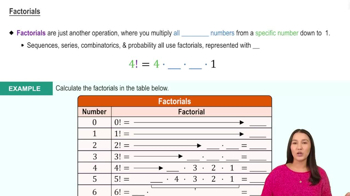
Factorials

A factorial, denoted by n!, is the product of all positive integers from 1 up to n. For example, 4! = 4 × 3 × 2 × 1 = 24. Factorials are commonly used in permutations, combinations, and series expansions, and knowing how to compute and simplify factorial expressions is crucial.
추천 영상:
5:22
Factorials

Alternating Series

An alternating series is a series whose terms alternate in sign, often indicated by factors like (−1)^i. This affects the sum by adding and subtracting terms in turn. Recognizing alternating series helps in understanding convergence behavior and calculating partial sums accurately.
추천 영상:
4:19
Example 2