Use the formula for the sum of the first n terms of a geometric sequence to solve Exercises 25–30. Find the sum of the first 14 terms of the geometric sequence: - 3/2, 3, - 6, 12, ...
Ch. 8 - Sequences, Induction, and Probability

9장, 문제 28
In Exercises 23–28, evaluate each factorial expression. (2n+1)!/(2n)!
검증된 단계별 안내1
Identify the factorial expressions in the problem: \((2n+1)!\) and \((2n)!\).
Recall the definition of a factorial: \(n! = n \times (n-1) \times (n-2) \times \ldots \times 1\).
Express \((2n+1)!\) in terms of \((2n)!\): \((2n+1)! = (2n+1) \times (2n)!\).
Substitute the expression for \((2n+1)!\) into the original problem: \(\frac{(2n+1) \times (2n)!}{(2n)!}\).
Simplify the expression by canceling out \((2n)!\) from the numerator and the denominator, leaving \(2n+1\).

비슷한 문제에 대한 검증된 영상 답변:
이 영상 해법은 위 문제에 도움이 된다고 튜터들이 추천한 것입니다.
영상 길이:
3m도움이 되었나요?
주요 개념
질문에 올바르게 답하기 위해 반드시 이해해야 하는 핵심 개념들은 다음과 같습니다.
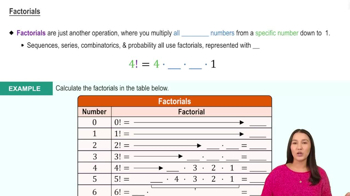
Factorial Definition
A factorial, denoted as n!, is the product of all positive integers from 1 to n. For example, 5! = 5 × 4 × 3 × 2 × 1 = 120. Factorials are used in permutations, combinations, and various mathematical calculations, making them fundamental in algebra and combinatorics.
추천 영상:
Factorials
Properties of Factorials
Factorials have specific properties that simplify calculations, such as n! = n × (n-1)! and 0! = 1. These properties allow for the reduction of factorial expressions, which is essential when evaluating complex factorial ratios like (2n+1)!/(2n)!. Understanding these properties helps in manipulating and simplifying expressions effectively.
추천 영상:
Factorials
Ratio of Factorials
The ratio of two factorials, such as (2n+1)!/(2n)!, can be simplified by canceling common terms. This involves recognizing that (2n+1)! = (2n+1) × (2n)!, allowing for the expression to reduce to (2n+1). This concept is crucial for evaluating factorial expressions efficiently and accurately.
추천 영상:
Factorials
관련 실천
교과서 질문
909
views
교과서 질문
Use mathematical induction to prove that each statement is true for every positive integer n. 6 is a factor of n(n + 1)(n + 2).
691
views
교과서 질문
Use mathematical induction to prove that each statement is true for every positive integer n.
736
views
교과서 질문
Use the Fundamental Counting Principle to solve Exercises 29–40. The model of the car you are thinking of buying is available in nine different colors and three different styles (hatchback, sedan, or sport). In how many ways can you order the car?
720
views
교과서 질문
Use the formula for the sum of the first n terms of a geometric sequence to solve Exercises 25–30. Find the sum of the first 11 terms of the geometric sequence: 3, - 6, 12, - 24, ...
945
views
교과서 질문
Evaluate each expression.
564
views