Ch. 8 - Sequences, Induction, and Probability
Blitzer - College Algebra 8th Edition
Blitzer8th EditionCollege AlgebraISBN: 9780136970514당신이 사용하는 게 아니라요?교과서 변경
9장, 문제 27

Use mathematical induction to prove that each statement is true for every positive integer n. 6 is a factor of n(n + 1)(n + 2).

검증된 단계별 안내
1
Start by defining the statement P(n): "6 is a factor of n(n + 1)(n + 2)" for every positive integer n. This means we want to prove that 6 divides the product n(n + 1)(n + 2).
Check the base case P(1): Calculate the product for n = 1, which is 1 \(\times\) 2 \(\times\) 3. Verify that 6 divides this product.
Assume the induction hypothesis P(k) is true for some positive integer k, meaning 6 divides k(k + 1)(k + 2). This means there exists an integer m such that k(k + 1)(k + 2) = 6m.
Prove the statement for P(k + 1): Consider the product (k + 1)(k + 2)(k + 3). Expand or manipulate this expression to relate it to k(k + 1)(k + 2) and use the induction hypothesis to show that 6 divides (k + 1)(k + 2)(k + 3).
Conclude that since the base case is true and the induction step holds, by mathematical induction, 6 is a factor of n(n + 1)(n + 2) for every positive integer n.

비슷한 문제에 대한 검증된 영상 답변:

이 영상 해법은 위 문제에 도움이 된다고 튜터들이 추천한 것입니다.
영상 길이:
4m
도움이 되었나요?

주요 개념

질문에 올바르게 답하기 위해 반드시 이해해야 하는 핵심 개념들은 다음과 같습니다.

Mathematical Induction

Mathematical induction is a proof technique used to show that a statement holds for all positive integers. It involves two steps: proving the base case (usually n=1) is true, and then proving that if the statement holds for an arbitrary integer k, it also holds for k+1. This creates a chain of truth for all n.
추천 영상:

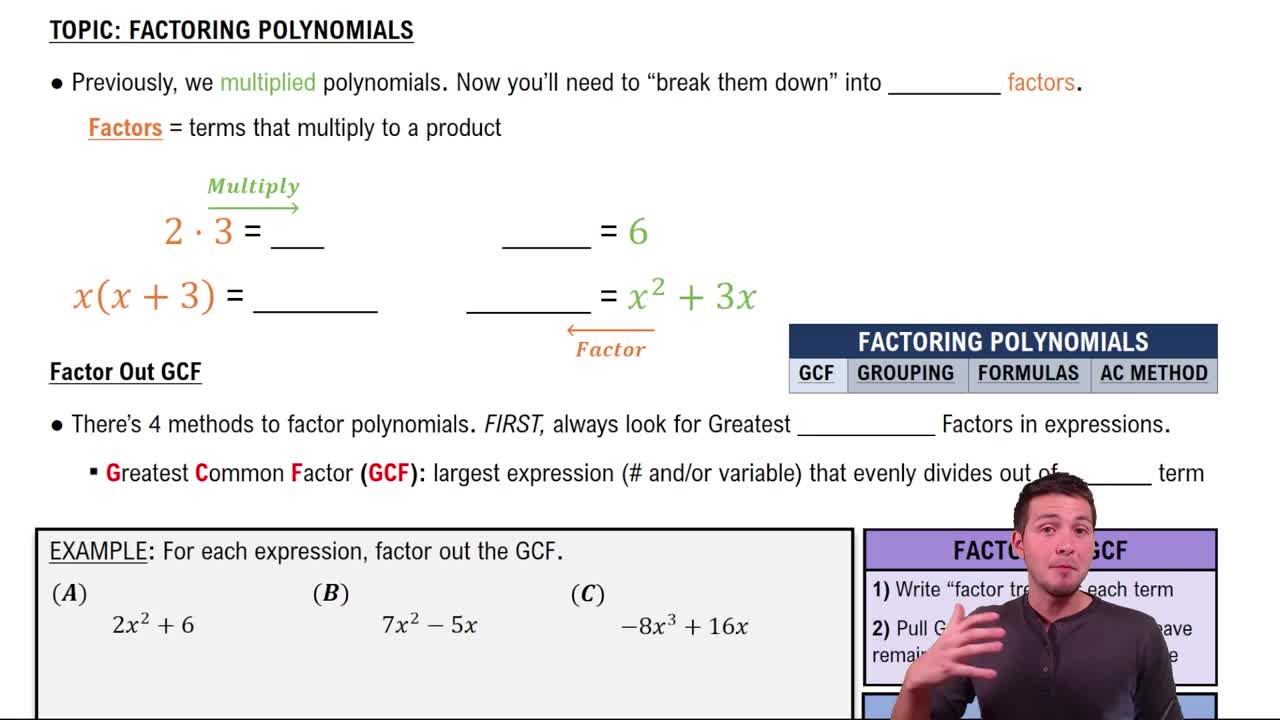
Divisibility and Factors

Divisibility means one integer is a factor of another if it divides it without leaving a remainder. In this problem, showing that 6 is a factor of n(n+1)(n+2) means proving the product is divisible by 6 for all positive integers n. Understanding factors and multiples is key to verifying divisibility.
추천 영상:
가이드 코스
07:30
Introduction to Factoring Polynomials

Properties of Consecutive Integers

The expression n(n+1)(n+2) involves three consecutive integers. Among any three consecutive integers, one is divisible by 2 and one is divisible by 3, ensuring the product is divisible by 6. Recognizing this property helps simplify the proof of divisibility.
추천 영상:
5:36
Change of Base Property