Ch. 8 - Sequences, Induction, and Probability
Blitzer - College Algebra 8th Edition
Blitzer8th EditionCollege AlgebraISBN: 9780136970514당신이 사용하는 게 아니라요?교과서 변경
9장, 문제 39

In Exercises 39–44, you are dealt one card from a 52-card deck. Find the probability that you are not dealt a king.

검증된 단계별 안내
1
Identify the total number of possible outcomes, which is the total number of cards in the deck. Since there are 52 cards, the total number of outcomes is \(52\).
Determine the number of favorable outcomes for the event 'not dealt a king.' Since there are 4 kings in the deck, the number of cards that are not kings is \(52 - 4 = 48\).
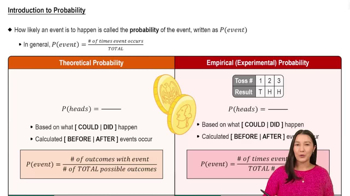
Recall that the probability of an event is given by the formula: \(\text{Probability} = \frac{\text{Number of favorable outcomes}}{\text{Total number of possible outcomes}}\).
Substitute the values into the formula: \(\text{Probability(not dealt a king)} = \frac{48}{52}\).
Simplify the fraction if possible to express the probability in simplest form.

비슷한 문제에 대한 검증된 영상 답변:

이 영상 해법은 위 문제에 도움이 된다고 튜터들이 추천한 것입니다.
영상 길이:
3m

주요 개념

질문에 올바르게 답하기 위해 반드시 이해해야 하는 핵심 개념들은 다음과 같습니다.

Basic Probability

Probability measures the likelihood of an event occurring, calculated as the ratio of favorable outcomes to total possible outcomes. In this problem, it involves finding the chance of not drawing a king from a deck.
추천 영상:
5:37
Introduction to Probability

Counting Outcomes in a Deck of Cards

A standard deck has 52 cards with 4 kings. Understanding the total number of cards and how many are kings is essential to determine favorable and unfavorable outcomes.
추천 영상:
4:04
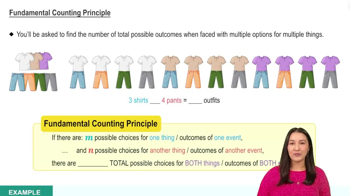
Fundamental Counting Principle

Complement Rule in Probability

The complement rule states that the probability of an event not happening equals one minus the probability that it does happen. Here, finding the probability of not getting a king is easier by subtracting the probability of getting a king from 1.
추천 영상:
5:37
Introduction to Probability