Ch. 8 - Sequences, Induction, and Probability
Blitzer - College Algebra 8th Edition
Blitzer8th EditionCollege AlgebraISBN: 9780136970514당신이 사용하는 게 아니라요?교과서 변경
9장, 문제 57

Use mathematical induction to prove that the statement is true for every positive integer n. 5 + 10 + 15 + ... + 5n = (5n(n+1))/2

검증된 단계별 안내
1
Step 1: Understand the problem. We are tasked with proving the formula for the sum of the series 5 + 10 + 15 + ... + 5n using mathematical induction. The formula to prove is S(n) = (5n(n+1))/2, where S(n) represents the sum of the first n terms of the series.
Step 2: Base case. Verify the formula for n = 1. Substitute n = 1 into the formula: S(1) = (5 * 1 * (1 + 1)) / 2. Calculate the left-hand side of the series, which is just the first term, 5. Show that both sides are equal, confirming the base case.
Step 3: Inductive hypothesis. Assume the formula is true for some positive integer k, i.e., assume S(k) = 5 + 10 + 15 + ... + 5k = (5k(k+1))/2. This assumption is called the inductive hypothesis and will be used to prove the formula for n = k + 1.
Step 4: Inductive step. Prove the formula for n = k + 1. Add the next term in the series, 5(k+1), to both sides of the inductive hypothesis: S(k+1) = S(k) + 5(k+1). Substitute the assumed formula for S(k) into this equation: S(k+1) = (5k(k+1))/2 + 5(k+1). Simplify the right-hand side to show it matches the formula (5(k+1)((k+1)+1))/2.
Step 5: Conclusion. Since the base case is true and the inductive step has been proven, by mathematical induction, the formula S(n) = (5n(n+1))/2 is true for all positive integers n.

비슷한 문제에 대한 검증된 영상 답변:

이 영상 해법은 위 문제에 도움이 된다고 튜터들이 추천한 것입니다.
영상 길이:
6m
도움이 되었나요?

주요 개념

질문에 올바르게 답하기 위해 반드시 이해해야 하는 핵심 개념들은 다음과 같습니다.

Mathematical Induction

Mathematical induction is a proof technique used to establish the truth of an infinite sequence of statements, typically involving integers. It consists of two main steps: the base case, where the statement is verified for the initial value (usually n=1), and the inductive step, where one assumes the statement holds for n=k and then proves it for n=k+1. This method is essential for proving statements that are asserted for all positive integers.
추천 영상:

Arithmetic Series

An arithmetic series is the sum of the terms of an arithmetic sequence, where each term after the first is obtained by adding a constant difference. In the given problem, the series 5 + 10 + 15 + ... + 5n can be expressed as an arithmetic series with a first term of 5, a common difference of 5, and n terms. Understanding the properties of arithmetic series is crucial for deriving the formula for the sum.
추천 영상:
가이드 코스
5:17
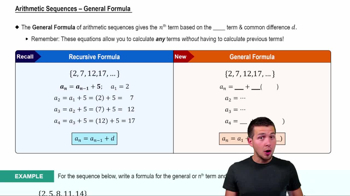
Arithmetic Sequences - General Formula

Formula for the Sum of an Arithmetic Series

The formula for the sum of the first n terms of an arithmetic series is given by S_n = n/2 * (a + l), where a is the first term, l is the last term, and n is the number of terms. In this case, the last term can be expressed as 5n, leading to the specific formula for the sum of the series in the problem. Recognizing how to apply this formula is key to proving the statement using induction.
추천 영상:
가이드 코스
5:17
Arithmetic Sequences - General Formula