Ch. 8 - Sequences, Induction, and Probability
Blitzer - College Algebra 8th Edition
Blitzer8th EditionCollege AlgebraISBN: 9780136970514당신이 사용하는 게 아니라요?교과서 변경
9장, 문제 58

Use mathematical induction to prove that the statement is true for every positive integer n. 1 + 4 + 4^2 + ... + 4^(n-1) = ((4^n)-1)/3

검증된 단계별 안내
1
Step 1: Understand the problem. We are tasked with proving the given formula using mathematical induction. Mathematical induction involves two main steps: the base case and the inductive step. The formula to prove is: 1 + 4 + 4^2 + ... + 4^(n-1) = ((4^n)-1)/3.
Step 2: Prove the base case. Substitute n = 1 into the formula. The left-hand side (LHS) becomes 4^(1-1) = 1. The right-hand side (RHS) becomes ((4^1)-1)/3 = (4-1)/3 = 1. Since LHS = RHS, the base case holds true.
Step 3: Assume the formula is true for some positive integer k. This is the inductive hypothesis. Assume 1 + 4 + 4^2 + ... + 4^(k-1) = ((4^k)-1)/3.
Step 4: Prove the formula for n = k + 1. Add the next term, 4^k, to both sides of the inductive hypothesis: (1 + 4 + 4^2 + ... + 4^(k-1)) + 4^k = ((4^k)-1)/3 + 4^k. Simplify the RHS to show it equals ((4^(k+1))-1)/3.
Step 5: Verify the simplification. Combine the terms on the RHS: ((4^k)-1)/3 + 4^k = ((4^(k+1))-1)/3. This confirms the formula holds for n = k + 1. Since the base case is true and the inductive step is proven, the formula is valid for all positive integers n.

비슷한 문제에 대한 검증된 영상 답변:

이 영상 해법은 위 문제에 도움이 된다고 튜터들이 추천한 것입니다.
영상 길이:
8m
도움이 되었나요?

주요 개념

질문에 올바르게 답하기 위해 반드시 이해해야 하는 핵심 개념들은 다음과 같습니다.

Mathematical Induction

Mathematical induction is a proof technique used to establish the truth of an infinite number of statements, typically concerning positive integers. It involves two main steps: the base case, where the statement is verified for the initial value (usually n=1), and the inductive step, where one assumes the statement holds for n=k and then proves it for n=k+1. This method is essential for proving formulas or properties that apply to all integers in a specified range.
추천 영상:

Geometric Series

A geometric series is a series of terms where each term after the first is found by multiplying the previous term by a constant called the common ratio. In the given statement, the series 1 + 4 + 4^2 + ... + 4^(n-1) is a geometric series with a first term of 1 and a common ratio of 4. Understanding the formula for the sum of a geometric series is crucial for simplifying and proving the statement in question.
추천 영상:
가이드 코스
4:18
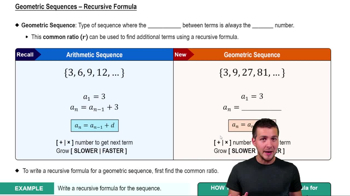
Geometric Sequences - Recursive Formula

Formula for the Sum of a Geometric Series

The formula for the sum of the first n terms of a geometric series is S_n = a(1 - r^n) / (1 - r), where 'a' is the first term and 'r' is the common ratio. For the series in the question, this formula can be applied to derive the expression ((4^n) - 1) / 3. Recognizing how to manipulate this formula is key to completing the proof by induction.
추천 영상:
가이드 코스
4:18
Geometric Sequences - Recursive Formula