Ch. P - Fundamental Concepts of Algebra
Blitzer - College Algebra 8th Edition
Blitzer8th EditionCollege AlgebraISBN: 9780136970514당신이 사용하는 게 아니라요?교과서 변경
1장, 문제 46

In Exercises 45–54, rationalize the denominator. 2/√10

검증된 단계별 안내
1
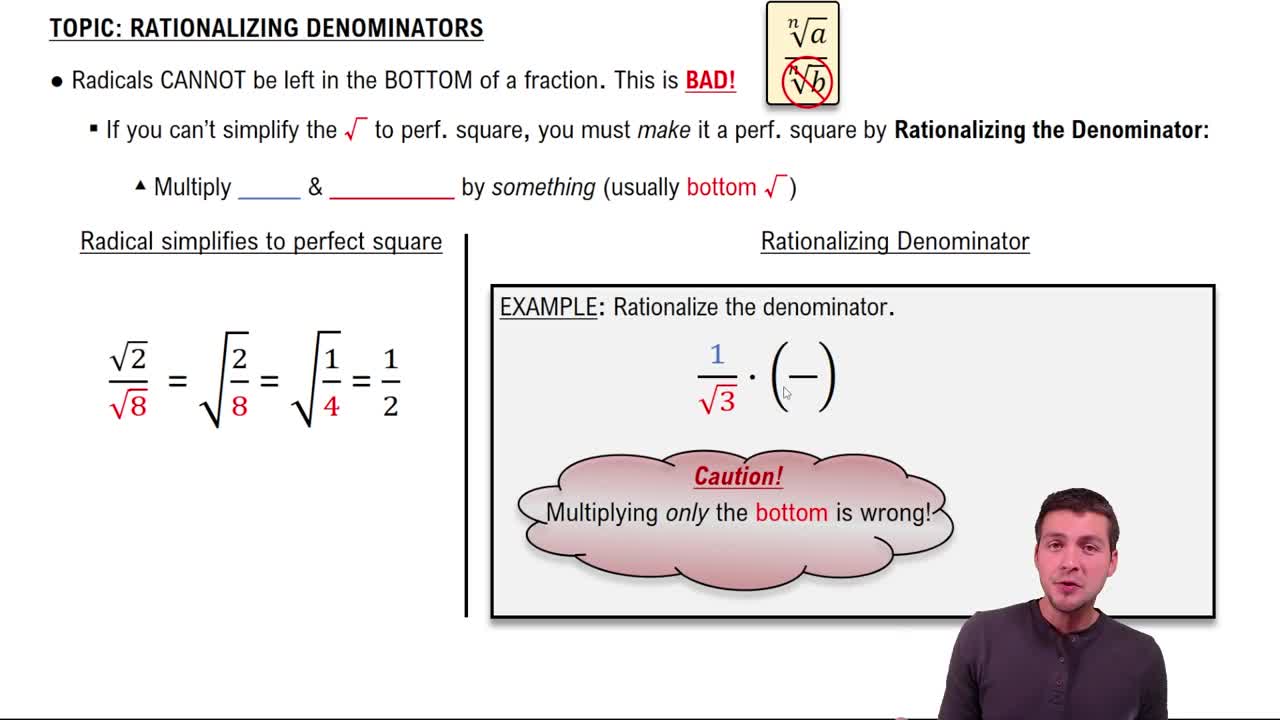
Identify the problem: The denominator contains a square root (√10), which is irrational. To rationalize the denominator, we need to eliminate the square root by multiplying both the numerator and denominator by the same square root.
Multiply both the numerator and denominator by √10. This step ensures that the value of the fraction remains unchanged, as multiplying by √10/√10 is equivalent to multiplying by 1.
Write the expression after multiplication: (2 × √10) / (√10 × √10). Simplify the denominator using the property of square roots: √a × √a = a.
Simplify the denominator: √10 × √10 = 10. The fraction now becomes (2√10) / 10.
Simplify the fraction further if possible by reducing the numerator and denominator. Check if there is a common factor between 2 and 10, and divide both by their greatest common divisor (GCD).

비슷한 문제에 대한 검증된 영상 답변:

이 영상 해법은 위 문제에 도움이 된다고 튜터들이 추천한 것입니다.
영상 길이:
1m
도움이 되었나요?

주요 개념

질문에 올바르게 답하기 위해 반드시 이해해야 하는 핵심 개념들은 다음과 같습니다.

Rationalizing the Denominator

Rationalizing the denominator involves eliminating any irrational numbers from the denominator of a fraction. This is typically achieved by multiplying both the numerator and the denominator by a suitable expression that will result in a rational number in the denominator. For example, to rationalize 2/√10, you would multiply by √10/√10.
추천 영상:
02:58
Rationalizing Denominators

Irrational Numbers

Irrational numbers are numbers that cannot be expressed as a simple fraction, meaning they cannot be written as the ratio of two integers. Common examples include square roots of non-perfect squares, such as √2 or √10. In the context of rationalizing denominators, the presence of an irrational number in the denominator is what necessitates the rationalization process.
추천 영상:
4:47
The Number e

Multiplication of Fractions

Multiplication of fractions involves multiplying the numerators together and the denominators together. When rationalizing a denominator, this principle is applied to ensure that the overall value of the fraction remains unchanged while transforming the denominator into a rational number. For instance, in the case of 2/√10, multiplying by √10/√10 results in (2√10)/(10), which simplifies the expression.
추천 영상:
05:45
Radical Expressions with Fractions