Ch. P - Fundamental Concepts of Algebra
Blitzer - College Algebra 8th Edition
Blitzer8th EditionCollege AlgebraISBN: 9780136970514당신이 사용하는 게 아니라요?교과서 변경
1장, 문제 47

Add or subtract terms whenever possible. 7√5 + 13√5

검증된 단계별 안내
1
Identify the like terms in the expression. Here, both terms have the radical \( \sqrt{5} \), so they are like terms.
Rewrite the expression by factoring out the common radical \( \sqrt{5} \): \( 7\sqrt{5} + 13\sqrt{5} = (7 + 13)\sqrt{5} \).
Add the coefficients of the like terms inside the parentheses: \( 7 + 13 \).
Express the simplified form as the product of the sum of coefficients and the common radical: \( (7 + 13)\sqrt{5} \).
Leave the expression in this simplified form without calculating the final numeric value.

비슷한 문제에 대한 검증된 영상 답변:

이 영상 해법은 위 문제에 도움이 된다고 튜터들이 추천한 것입니다.
영상 길이:
2m
도움이 되었나요?

주요 개념

질문에 올바르게 답하기 위해 반드시 이해해야 하는 핵심 개념들은 다음과 같습니다.

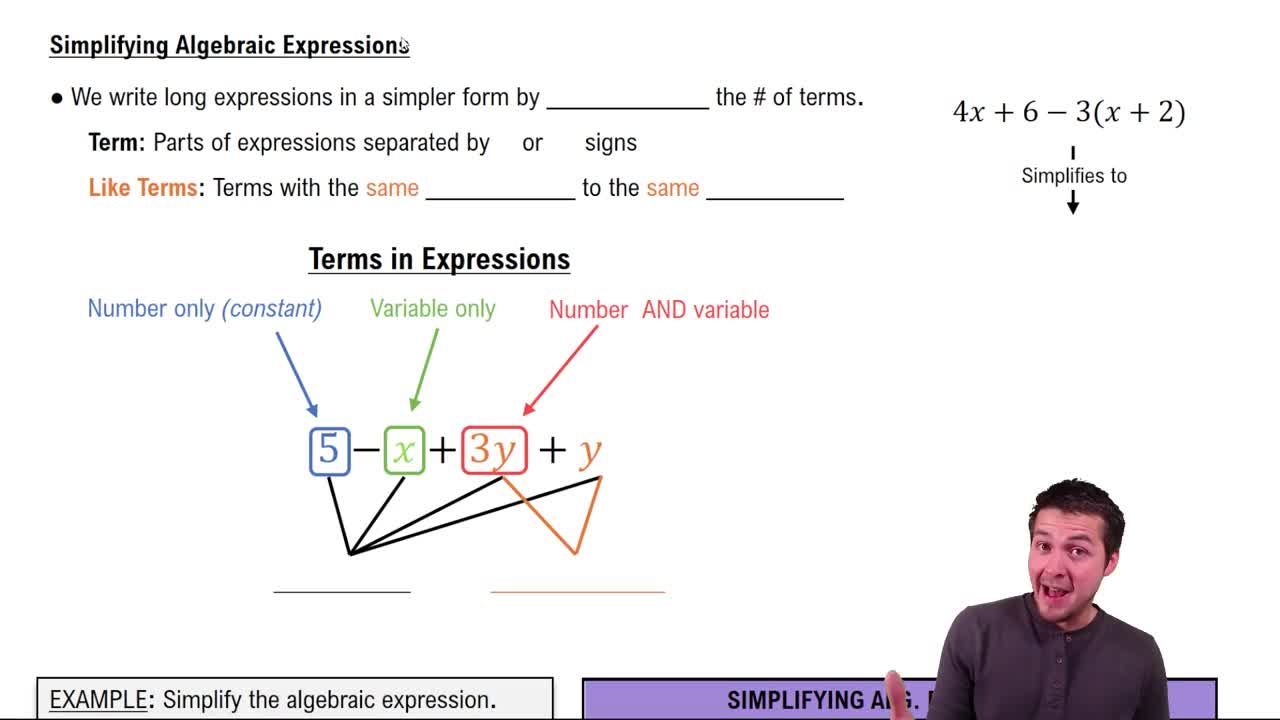
Like Terms in Algebra

Like terms are terms that have the same variable parts raised to the same powers. In the context of radicals, terms with the same radicand (number under the root) are considered like terms and can be combined by adding or subtracting their coefficients.
추천 영상:
05:07
Simplifying Algebraic Expressions

Simplifying Radicals

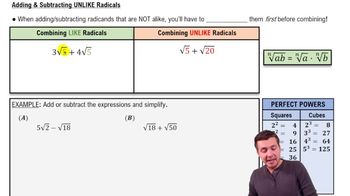
Simplifying radicals involves expressing the root in its simplest form by factoring out perfect squares or cubes. This process helps identify like terms and makes it easier to combine them when adding or subtracting.
추천 영상:
5:48
Adding & Subtracting Unlike Radicals by Simplifying

Addition and Subtraction of Radical Expressions

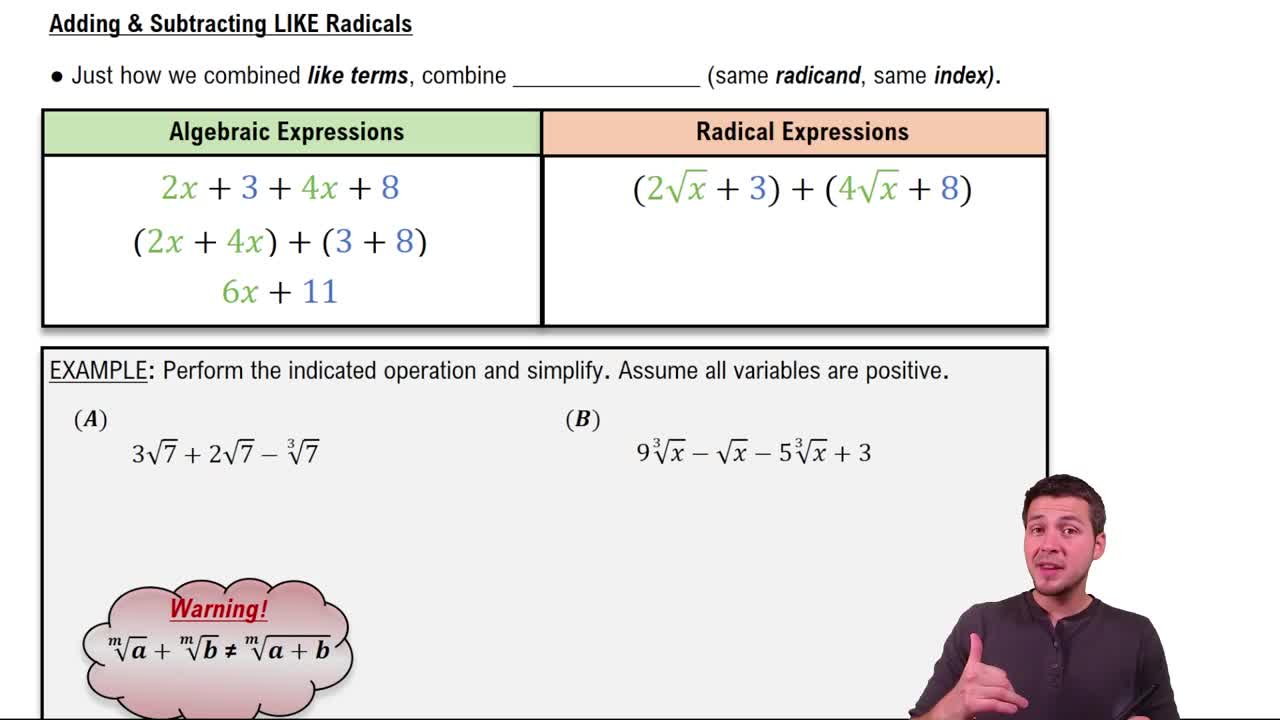
When adding or subtracting radical expressions, only like radicals (same radicand and root) can be combined by adding or subtracting their coefficients. For example, 7√5 + 13√5 equals (7 + 13)√5 = 20√5.
추천 영상:
03:50
Adding & Subtracting Like Radicals