Use the intermediate value theorem to show that each polynomial function has a real zero between the numbers given. ƒ(x)=x4-4x3-x+3; 0.5 and 1
Ch. 3 - Polynomial and Rational Functions

4장, 문제 52
For each polynomial function, find all zeros and their multiplicities.
검증된 단계별 안내1
Identify the factors of the polynomial function: \(f(x) = (2x^2 - 7x + 3)^3 (x - 2 - \sqrt{5})\). The zeros come from setting each factor equal to zero.
Find the zeros of the quadratic factor \(2x^2 - 7x + 3\) by using the quadratic formula: \(x = \frac{-b \pm \sqrt{b^2 - 4ac}}{2a}\), where \(a=2\), \(b=-7\), and \(c=3\).
Calculate the discriminant \(\Delta = b^2 - 4ac\) to determine the nature of the roots of the quadratic. Then substitute into the quadratic formula to find the two zeros.
Note that each zero from the quadratic factor has multiplicity 3 because the entire quadratic is raised to the third power.
Find the zero from the linear factor \(x - 2 - \sqrt{5} = 0\), which gives \(x = 2 + \sqrt{5}\), and note that this zero has multiplicity 1 since the factor is to the first power.

비슷한 문제에 대한 검증된 영상 답변:
이 영상 해법은 위 문제에 도움이 된다고 튜터들이 추천한 것입니다.
영상 길이:
5m도움이 되었나요?
주요 개념
질문에 올바르게 답하기 위해 반드시 이해해야 하는 핵심 개념들은 다음과 같습니다.
Polynomial Zeros
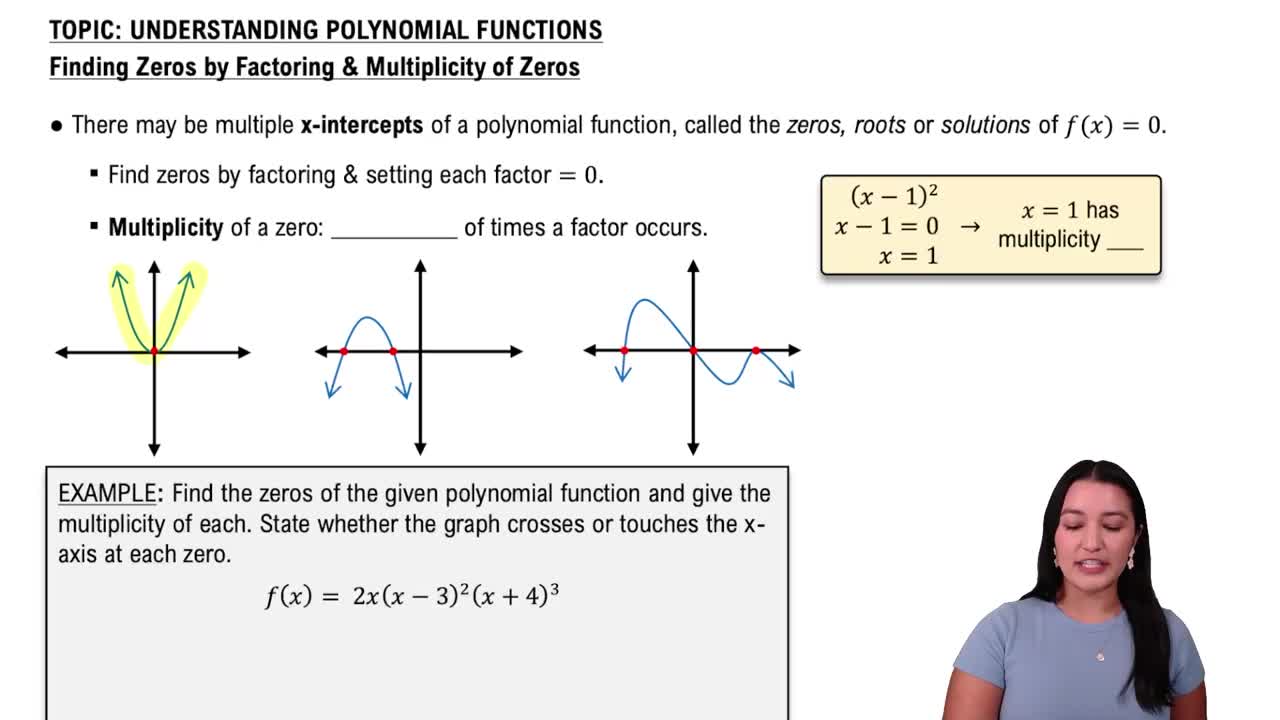
Zeros of a polynomial are the values of x for which the polynomial equals zero. Finding zeros involves solving the equation f(x) = 0, which may require factoring or using formulas. These zeros represent the roots or x-intercepts of the polynomial function.
추천 영상:
Finding Zeros & Their Multiplicity
Multiplicity of Zeros
Multiplicity refers to the number of times a particular zero appears as a factor in the polynomial. If a factor is raised to a power n, the zero associated with that factor has multiplicity n. Multiplicity affects the graph's behavior at the zero, such as whether it crosses or touches the x-axis.
추천 영상:
Finding Zeros & Their Multiplicity
Factoring and Solving Quadratic Expressions
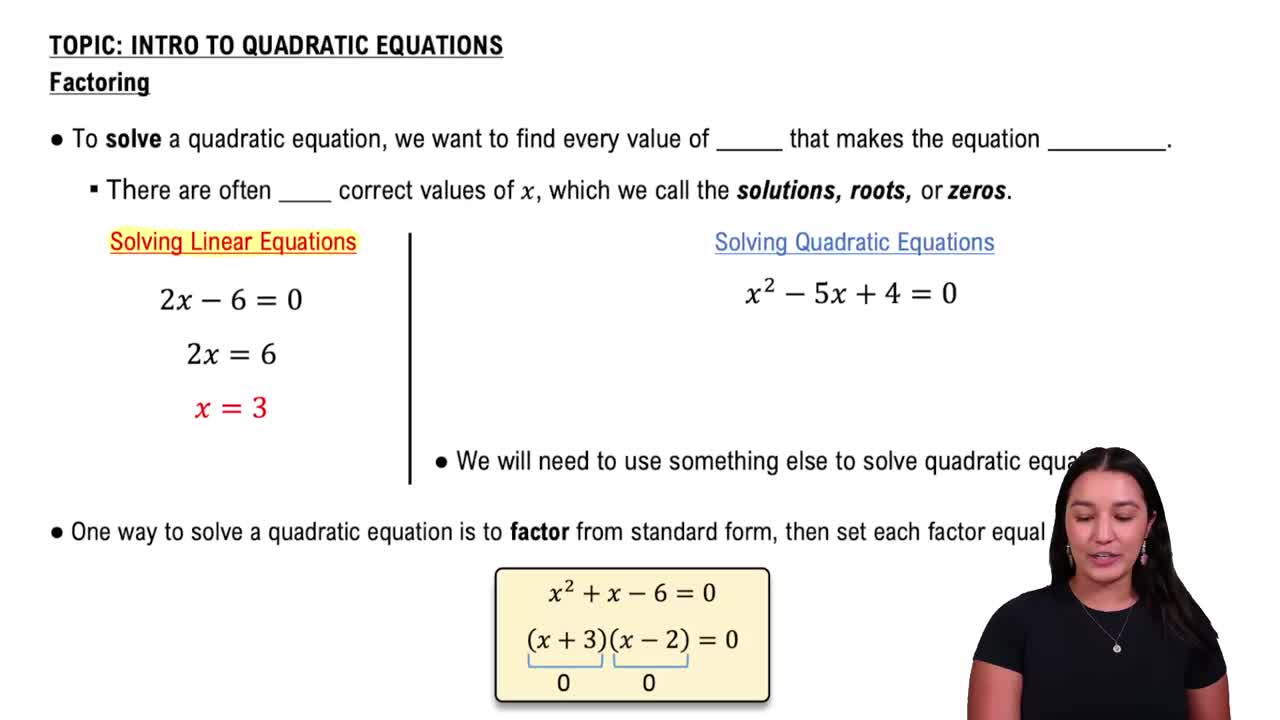
Factoring quadratic expressions like 2x² - 7x + 3 helps find zeros by rewriting the polynomial as a product of linear factors. When factoring is difficult, the quadratic formula can be used. This step is essential to break down complex polynomials into simpler parts to identify zeros.
추천 영상:
Solving Quadratic Equations by Factoring
관련 실천
교과서 질문
777
views
교과서 질문
Use synthetic division to determine whether the given number k is a zero of the polynomial function. If it is not, give the value of ƒ(k). ƒ(x) = 2x3 - 6x2 -9x + 4; k=1
389
views
교과서 질문
Work each problem. Which function has a graph that does not have a vertical asymptote?
A. ƒ(x)=1/(x2+2)
B. ƒ(x)=1/(x2-2)
C. ƒ(x)=3/x2
D. ƒ(x)=(2x+1)/(x-8)
638
views
교과서 질문
Graph each polynomial function. ƒ(x)=-2x4+7x3-4x2-4x
972
views
교과서 질문
Work each problem. Which function has a graph that does not have a horizontal asymptote?
A. ƒ(x)=(2x-7)/(x+3)
B. ƒ(x)=3x/(x2-9)
C. ƒ(x)=(x2-9)/(x+3)
D. ƒ(x)=(x+5)/(x+2)(x-3)
719
views
교과서 질문
Use the intermediate value theorem to show that each polynomial function has a real zero between the numbers given. ƒ(x)=2x4-4x2+4x-8; 1 and 2
1058
views