Use synthetic division to determine whether the given number k is a zero of the polynomial function. If it is not, give the value of ƒ(k). ƒ(x) = 2x3 - 6x2 -9x + 4; k=1
Ch. 3 - Polynomial and Rational Functions

4장, 문제 52
Use the intermediate value theorem to show that each polynomial function has a real zero between the numbers given. ƒ(x)=x4-4x3-x+3; 0.5 and 1
검증된 단계별 안내1
Recall the Intermediate Value Theorem (IVT), which states that if a function \( f(x) \) is continuous on a closed interval \([a, b]\) and \( f(a) \) and \( f(b) \) have opposite signs, then there exists at least one \( c \) in \((a, b)\) such that \( f(c) = 0 \).
Identify the function \( f(x) = x^4 - 4x^3 - x + 3 \) and the interval \([0.5, 1]\). Since \( f(x) \) is a polynomial, it is continuous everywhere, including on this interval.
Evaluate \( f(0.5) \) by substituting \( x = 0.5 \) into the function: \( f(0.5) = (0.5)^4 - 4(0.5)^3 - 0.5 + 3 \).
Evaluate \( f(1) \) by substituting \( x = 1 \) into the function: \( f(1) = (1)^4 - 4(1)^3 - 1 + 3 \).
Check the signs of \( f(0.5) \) and \( f(1) \). If one is positive and the other is negative, then by the IVT, there is at least one real zero of \( f(x) \) between 0.5 and 1.

비슷한 문제에 대한 검증된 영상 답변:
이 영상 해법은 위 문제에 도움이 된다고 튜터들이 추천한 것입니다.
영상 길이:
5m도움이 되었나요?
주요 개념
질문에 올바르게 답하기 위해 반드시 이해해야 하는 핵심 개념들은 다음과 같습니다.
Intermediate Value Theorem
The Intermediate Value Theorem states that if a function is continuous on a closed interval [a, b] and takes values f(a) and f(b) at each end, then it must take any value between f(a) and f(b) at some point within the interval. This theorem is used to prove the existence of roots when the function changes sign.
추천 영상:
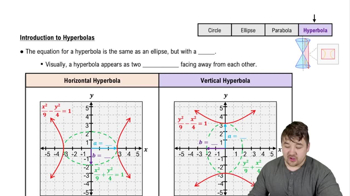
Introduction to Hyperbolas
Polynomial Continuity
Polynomial functions are continuous everywhere on the real number line, meaning there are no breaks, jumps, or holes in their graphs. This continuity ensures that the Intermediate Value Theorem can be applied to any interval when analyzing polynomial functions.
추천 영상:
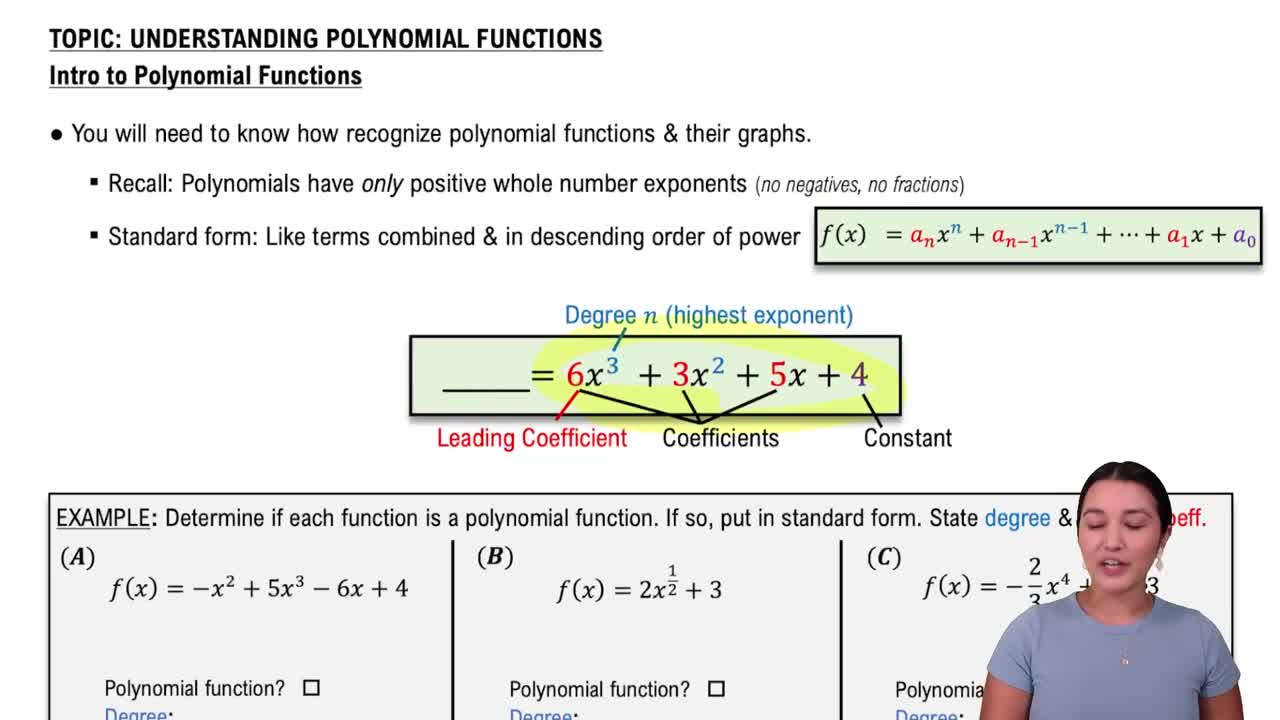
Introduction to Polynomial Functions
Evaluating Function Values at Interval Endpoints
To apply the Intermediate Value Theorem, you must calculate the function's values at the given interval endpoints. If the function values have opposite signs, it indicates the function crosses zero within the interval, confirming the existence of a real root.
추천 영상:
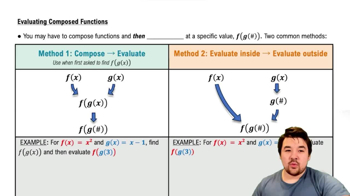
Evaluating Composed Functions
관련 실천
교과서 질문
389
views
교과서 질문
Work each problem. Which function has a graph that does not have a vertical asymptote?
A. ƒ(x)=1/(x2+2)
B. ƒ(x)=1/(x2-2)
C. ƒ(x)=3/x2
D. ƒ(x)=(2x+1)/(x-8)
638
views
교과서 질문
Graph each polynomial function. ƒ(x)=-2x4+7x3-4x2-4x
972
views
교과서 질문
For each polynomial function, find all zeros and their multiplicities.
660
views
교과서 질문
Work each problem. Which function has a graph that does not have a horizontal asymptote?
A. ƒ(x)=(2x-7)/(x+3)
B. ƒ(x)=3x/(x2-9)
C. ƒ(x)=(x2-9)/(x+3)
D. ƒ(x)=(x+5)/(x+2)(x-3)
719
views
교과서 질문
Use the intermediate value theorem to show that each polynomial function has a real zero between the numbers given. ƒ(x)=2x4-4x2+4x-8; 1 and 2
1058
views