Ch. 3 - Polynomial and Rational Functions
Lial - College Algebra 13th Edition
Lial13th EditionCollege AlgebraISBN: 9780136881063당신이 사용하는 게 아니라요?교과서 변경
4장, 문제 58

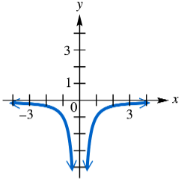
Identify any vertical, horizontal, or oblique asymptotes in the graph of y=f(x)y=f\(\left\)(x\(\right\)). State the domain of ff.
Graph of a rational function showing vertical asymptote at x=1 and horizontal asymptote at y=0.

검증된 단계별 안내
1
Step 1: Identify the function \( f(x) \) from the given graph or expression. Since the problem references a graph, observe the behavior of the function near points where it might be undefined or where the graph shows unusual behavior (like breaks or infinite limits).
Step 2: Find vertical asymptotes by locating values of \( x \) where the function is undefined and the limit of \( f(x) \) approaches infinity or negative infinity. Typically, these occur where the denominator of a rational function is zero (if applicable). Write these values as vertical asymptotes \( x = a \).
Step 3: Determine horizontal asymptotes by analyzing the end behavior of the function as \( x \to \infty \) and \( x \to -\infty \). Calculate \( \lim_{x \to \infty} f(x) \) and \( \lim_{x \to -\infty} f(x) \). If these limits approach a finite number \( L \), then \( y = L \) is a horizontal asymptote.
Step 4: Check for oblique (slant) asymptotes if the degree of the numerator is exactly one more than the degree of the denominator (for rational functions). Perform polynomial long division of the numerator by the denominator to find the quotient \( q(x) \). The oblique asymptote is given by \( y = q(x) \) (a linear function).
Step 5: State the domain of \( f \) by excluding any values of \( x \) that cause the function to be undefined (such as points where the denominator is zero or where the function has vertical asymptotes). Express the domain in interval notation.

비슷한 문제에 대한 검증된 영상 답변:

이 영상 해법은 위 문제에 도움이 된다고 튜터들이 추천한 것입니다.
영상 길이:
2m
도움이 되었나요?

주요 개념

질문에 올바르게 답하기 위해 반드시 이해해야 하는 핵심 개념들은 다음과 같습니다.

Vertical Asymptotes

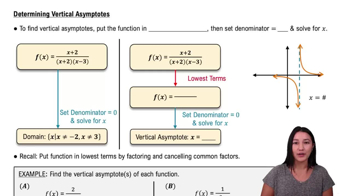
Vertical asymptotes occur where the function approaches infinity or negative infinity as the input approaches a specific value, often where the denominator of a rational function is zero. They represent values excluded from the domain and indicate where the graph has a vertical line that the curve approaches but never touches.
추천 영상:
3:12
Determining Vertical Asymptotes

Horizontal and Oblique Asymptotes

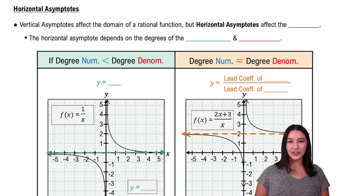
Horizontal asymptotes describe the behavior of a function as the input approaches positive or negative infinity, showing the value the function approaches. Oblique (slant) asymptotes occur when the function approaches a non-horizontal line, typically found by polynomial division when the numerator’s degree is exactly one more than the denominator’s.
추천 영상:
4:48
Determining Horizontal Asymptotes

Domain of a Function

The domain of a function is the set of all input values (x-values) for which the function is defined. For rational functions, the domain excludes values that make the denominator zero. Identifying the domain is essential to understanding where the function exists and where asymptotes may occur.
추천 영상:
3:51
Domain Restrictions of Composed Functions