Ch. 3 - Polynomial and Rational Functions
Lial - College Algebra 13th Edition
Lial13th EditionCollege AlgebraISBN: 9780136881063당신이 사용하는 게 아니라요?교과서 변경
4장, 문제 58

Solve each rational inequality. Give the solution set in interval notation. 20/(x - 1) ≥ 1

검증된 단계별 안내
1
Start by rewriting the inequality: \(\frac{20}{x - 1} \geq 1\).
Bring all terms to one side to have zero on the other side: \(\frac{20}{x - 1} - 1 \geq 0\).
Find a common denominator and combine the terms into a single rational expression: \(\frac{20 - (x - 1)}{x - 1} \geq 0\).
Simplify the numerator: \(\frac{21 - x}{x - 1} \geq 0\).
Determine the critical points by setting numerator and denominator equal to zero: \(21 - x = 0\) and \(x - 1 = 0\), then analyze the sign of the expression on intervals defined by these points to find where the inequality holds.

비슷한 문제에 대한 검증된 영상 답변:

이 영상 해법은 위 문제에 도움이 된다고 튜터들이 추천한 것입니다.
영상 길이:
9m
도움이 되었나요?

주요 개념

질문에 올바르게 답하기 위해 반드시 이해해야 하는 핵심 개념들은 다음과 같습니다.

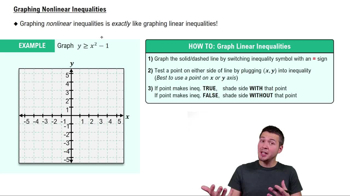
Rational Inequalities

Rational inequalities involve expressions where one or both sides contain rational functions, which are ratios of polynomials. Solving them requires finding values of the variable that make the inequality true, often by analyzing the sign of the expression and considering restrictions from denominators.
추천 영상:
가이드 코스
3:21
Nonlinear Inequalities

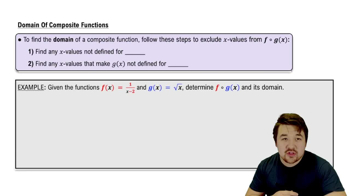
Domain Restrictions

When solving rational inequalities, it is crucial to identify values that make the denominator zero, as these are excluded from the domain. These restrictions help determine critical points that divide the number line into intervals for testing the inequality.
추천 영상:
3:51
Domain Restrictions of Composed Functions

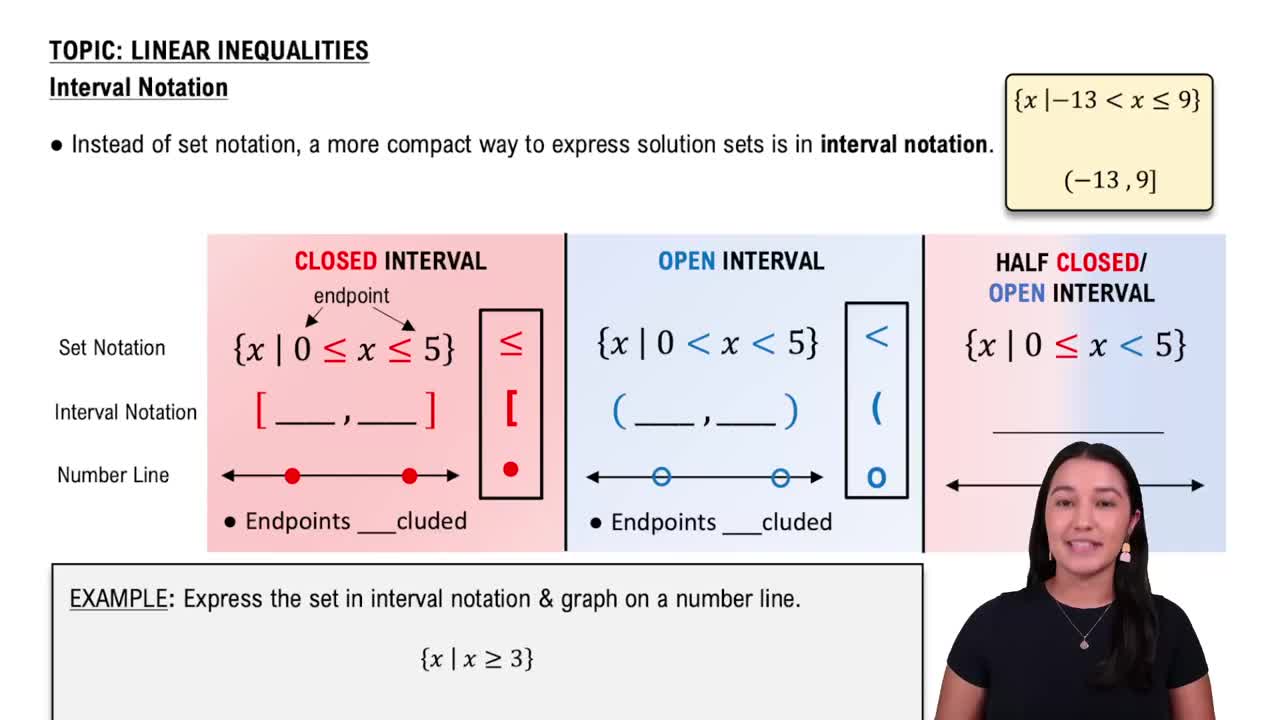
Interval Testing and Interval Notation

After finding critical points, the number line is divided into intervals. Each interval is tested to see if it satisfies the inequality. The solution set is then expressed in interval notation, which concisely represents all values that satisfy the inequality.
추천 영상:
05:18
Interval Notation