Ch. 3 - Polynomial and Rational Functions
Lial - College Algebra 13th Edition
Lial13th EditionCollege AlgebraISBN: 9780136881063당신이 사용하는 게 아니라요?교과서 변경
4장, 문제 29

Solve each polynomial inequality. Give the solution set in interval notation. (x - 3)(x - 4)(x - 5)2 ≤ 0

검증된 단계별 안내
1
First, identify the critical points by setting each factor equal to zero: solve \(x - 3 = 0\), \(x - 4 = 0\), and \(x - 5 = 0\). These points divide the number line into intervals.
Next, determine the multiplicity of each root: \(x = 3\) and \(x = 4\) have multiplicity 1 (since their factors are to the first power), and \(x = 5\) has multiplicity 2 (since \((x - 5)^2\) is squared).
Then, choose test points from each interval created by the critical points (for example, values less than 3, between 3 and 4, between 4 and 5, and greater than 5) and substitute them into the expression \((x - 3)(x - 4)(x - 5)^2\) to determine the sign (positive or negative) of the product in each interval.
Analyze the sign of the product on each interval, remembering that factors raised to an even power (like \((x - 5)^2\)) are always non-negative, which affects the overall sign of the product.
Finally, combine the intervals where the product is less than or equal to zero (\(\leq 0\)) and include the critical points where the expression equals zero, then express the solution set in interval notation.

비슷한 문제에 대한 검증된 영상 답변:

이 영상 해법은 위 문제에 도움이 된다고 튜터들이 추천한 것입니다.
영상 길이:
9m
도움이 되었나요?

주요 개념

질문에 올바르게 답하기 위해 반드시 이해해야 하는 핵심 개념들은 다음과 같습니다.

Polynomial Inequalities

Polynomial inequalities involve expressions where a polynomial is compared to zero or another value using inequality signs (>, <, ≥, ≤). Solving them requires finding the values of the variable that make the inequality true, often by analyzing the sign of the polynomial over different intervals.
추천 영상:
06:07
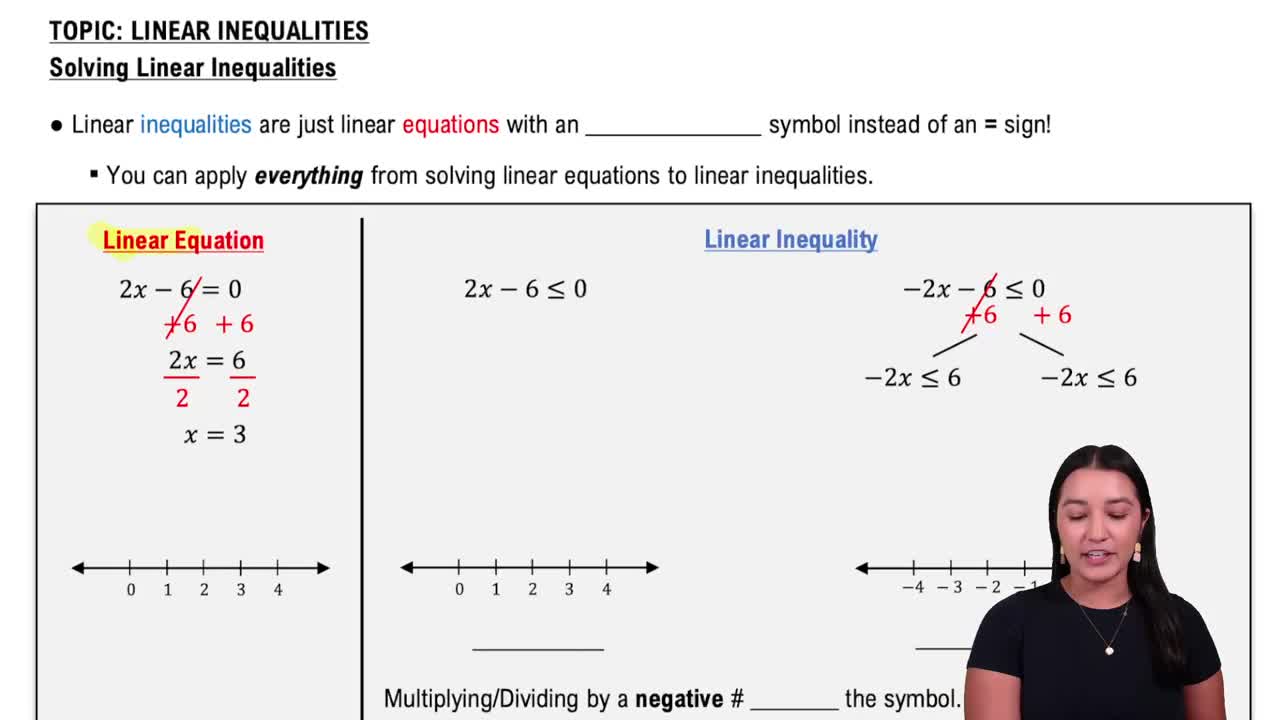
Linear Inequalities

Critical Points and Sign Analysis

Critical points are the roots of the polynomial where the expression equals zero. These points divide the number line into intervals. By testing values in each interval, you determine whether the polynomial is positive or negative there, which helps identify where the inequality holds.
추천 영상:
가이드 코스
05:46
Point-Slope Form

Multiplicity of Roots

The multiplicity of a root refers to how many times a factor appears in the polynomial. Even multiplicities cause the graph to touch the x-axis and turn around, not crossing it, while odd multiplicities cause the graph to cross the axis. This affects the sign changes around critical points.
추천 영상:
02:20
Imaginary Roots with the Square Root Property