Resistance of a Wire The resistance in ohms of a platinum wire temperature sensor varies directly as the temperature in kelvins (K). If the resistance is 646 ohms at a temperature of 190 K, find the resistance at a temperature of 250 K.
Ch. 3 - Polynomial and Rational Functions

4장, 문제 28
Use an end behavior diagram, as shown below, to describe the end behavior of the graph of each polynomial function. ƒ(x)=7+2x-5x2-10x4


검증된 단계별 안내1
Identify the degree of the polynomial function. The given function is \(f(x) = 7 + 2x - 5x^2 - 10x^4\). The degree is the highest power of \(x\), which is 4 in this case.
Determine the leading term of the polynomial, which is the term with the highest degree. Here, the leading term is \(-10x^4\).
Analyze the leading coefficient and the degree to understand the end behavior. The leading coefficient is \(-10\), which is negative, and the degree 4 is even.
Recall the end behavior rules for polynomials: For even degree and negative leading coefficient, as \(x \to \infty\), \(f(x) \to -\infty\), and as \(x \to -\infty\), \(f(x) \to -\infty\).
Use this information to draw or describe the end behavior diagram, showing both ends of the graph going downwards toward negative infinity.

비슷한 문제에 대한 검증된 영상 답변:
이 영상 해법은 위 문제에 도움이 된다고 튜터들이 추천한 것입니다.
영상 길이:
2m주요 개념
질문에 올바르게 답하기 위해 반드시 이해해야 하는 핵심 개념들은 다음과 같습니다.
Polynomial Degree and Leading Term
The degree of a polynomial is the highest power of the variable in the expression, and the leading term is the term with this highest power. The degree and leading coefficient determine the general shape and end behavior of the polynomial's graph.
추천 영상:
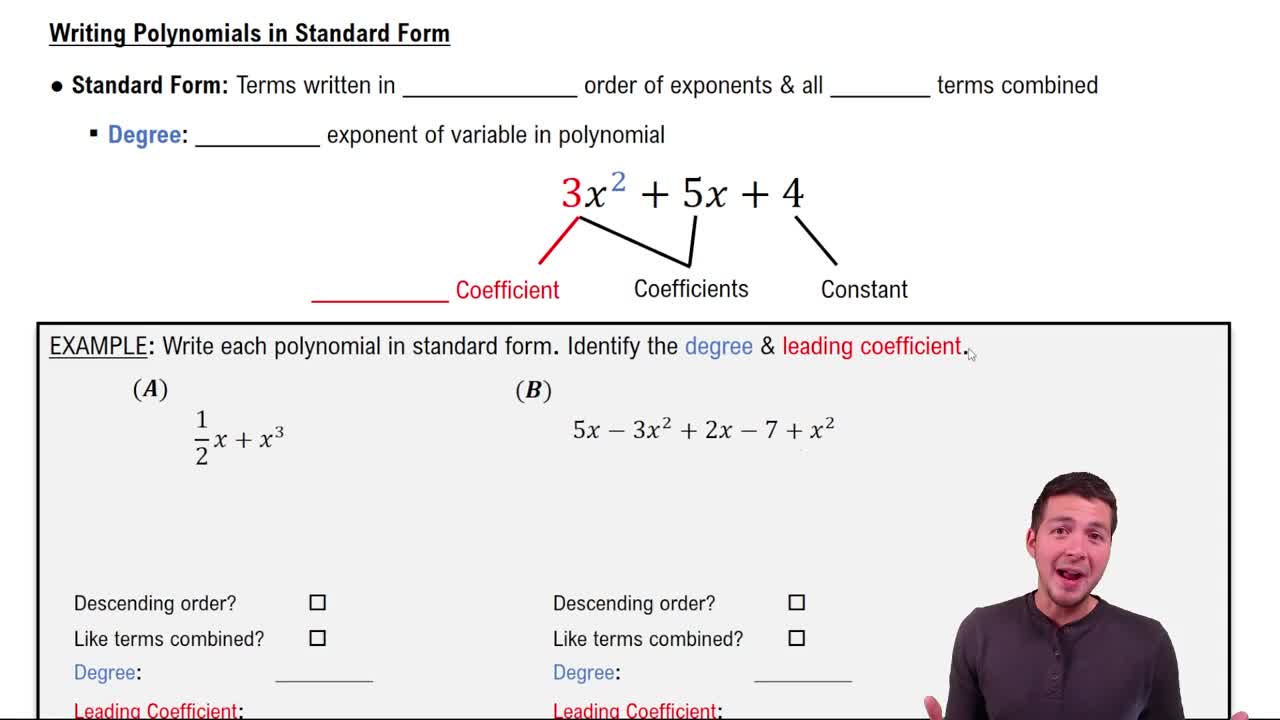
Standard Form of Polynomials
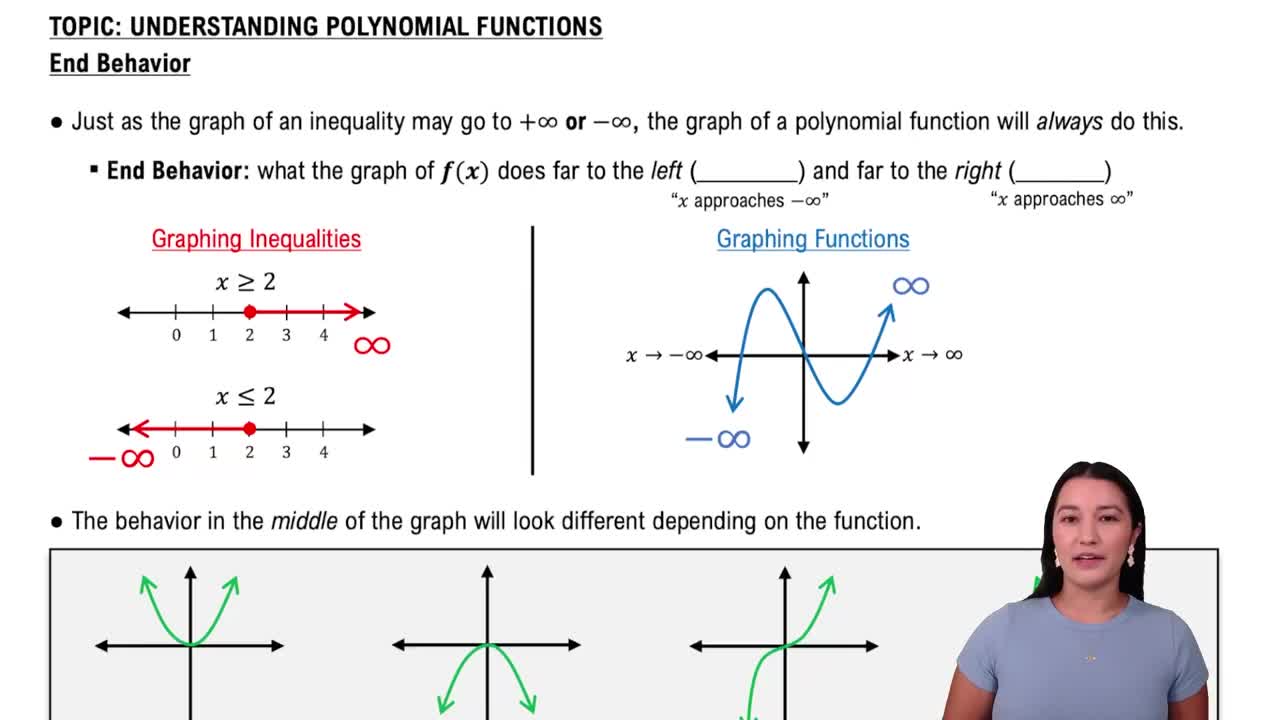
End Behavior of Polynomial Functions
End behavior describes how the values of a polynomial function behave as x approaches positive or negative infinity. It depends primarily on the degree and leading coefficient: even-degree polynomials with positive leading coefficients rise on both ends, while odd-degree polynomials have opposite end behaviors.
추천 영상:
End Behavior of Polynomial Functions
Using End Behavior Diagrams
End behavior diagrams visually represent the direction of the graph's ends, typically using arrows pointing up or down on the left and right sides. These diagrams help quickly identify how the polynomial behaves for large positive and negative x-values.
추천 영상:
End Behavior of Polynomial Functions
관련 실천
교과서 질문
496
views
교과서 질문
Match the rational function in Column I with the appropriate description in Column II. Choices in Column II can be used only once.
762
views
교과서 질문
Solve each polynomial inequality. Give the solution set in interval notation. (x - 3)(x - 4)(x - 5)2 ≤ 0
501
views
교과서 질문
Solve each polynomial inequality. Give the solution set in interval notation. (x - 4)(2x + 3)(3x - 1) ≥ 0
471
views
교과서 질문
Use an end behavior diagram, as shown below, to describe the end behavior of the graph of each polynomial function. ƒ(x)=3+2x-4x2-5x10
1040
views
교과서 질문
Graph each quadratic function. Give the (a) vertex, (b) axis, (c) domain, and (d) range. ƒ(x) = -3 (x - 2)2 +1
1046
views
