Use an end behavior diagram, as shown below, to describe the end behavior of the graph of each polynomial function. ƒ(x)=7+2x-5x2-10x4
Ch. 3 - Polynomial and Rational Functions

4장, 문제 27
Use an end behavior diagram, as shown below, to describe the end behavior of the graph of each polynomial function. ƒ(x)=3+2x-4x2-5x10


검증된 단계별 안내1
Identify the degree and leading coefficient of the polynomial function. The given function is \(f(x) = 3 + 2x - 4x^2 - 5x^{10}\). The term with the highest power of \(x\) is \(-5x^{10}\), so the degree is 10 and the leading coefficient is \(-5\).
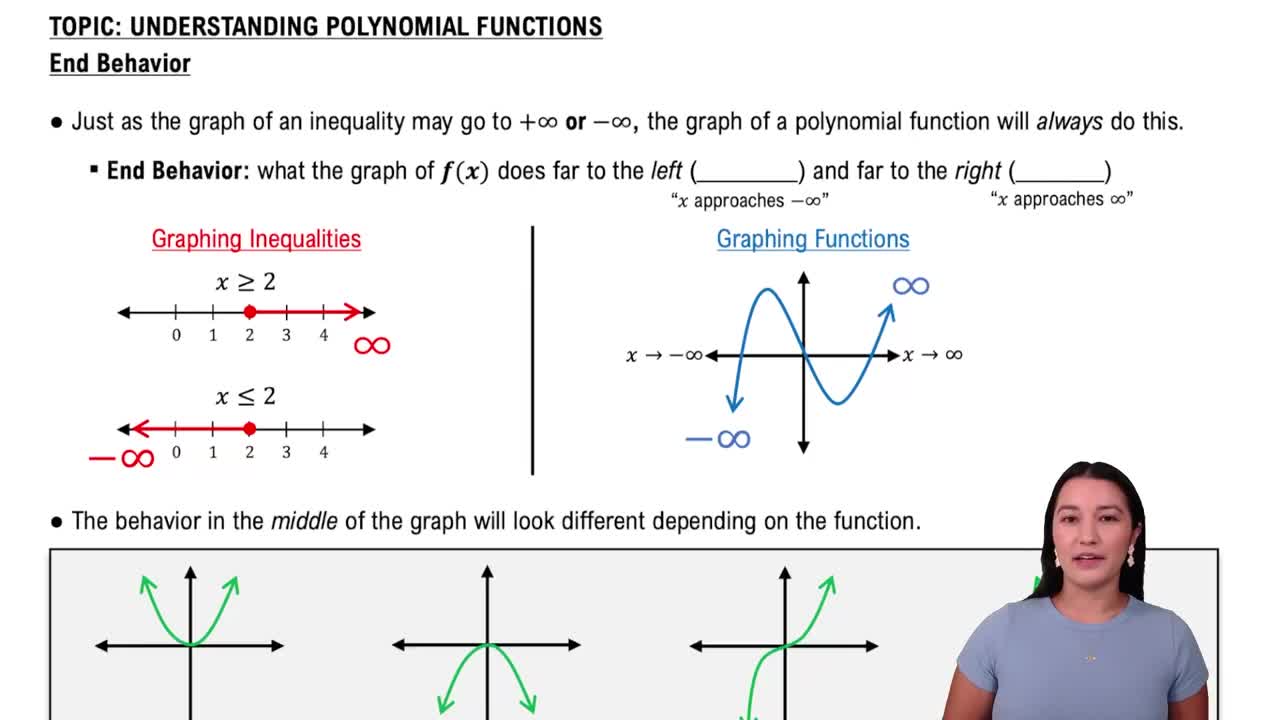
Determine the end behavior based on the degree and leading coefficient. Since the degree is even (10) and the leading coefficient is negative (\(-5\)), the ends of the graph will both point downwards.
Express the end behavior in terms of limits: As \(x \to \infty\), \(f(x) \to -\infty\) and as \(x \to -\infty\), \(f(x) \to -\infty\).
Draw or visualize the end behavior diagram: both ends of the graph go down towards negative infinity.
Summarize the end behavior: The graph falls to negative infinity on both the left and right ends because the leading term dominates the behavior for very large positive and negative values of \(x\).

비슷한 문제에 대한 검증된 영상 답변:
이 영상 해법은 위 문제에 도움이 된다고 튜터들이 추천한 것입니다.
영상 길이:
2m주요 개념
질문에 올바르게 답하기 위해 반드시 이해해야 하는 핵심 개념들은 다음과 같습니다.
Polynomial Functions and Degree
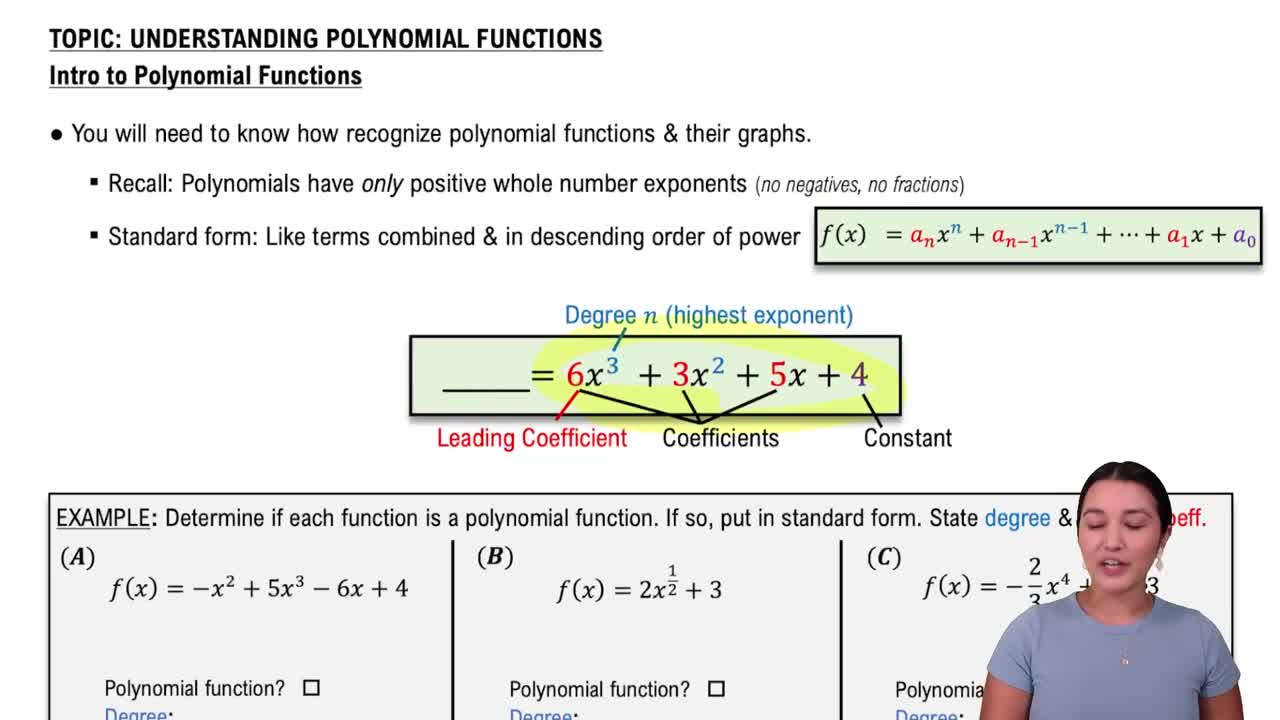
A polynomial function is an expression consisting of variables raised to whole-number exponents and their coefficients. The degree of the polynomial is the highest exponent of the variable, which largely determines the shape and end behavior of its graph.
추천 영상:
Introduction to Polynomial Functions
Leading Term and Leading Coefficient
The leading term of a polynomial is the term with the highest degree, and its coefficient is the leading coefficient. These determine the end behavior of the polynomial's graph, indicating how the function behaves as x approaches positive or negative infinity.
추천 영상:
End Behavior of Polynomial Functions
End Behavior of Polynomial Graphs
End behavior describes how the values of a polynomial function behave as x approaches infinity or negative infinity. It depends on the degree and leading coefficient: even-degree polynomials with positive leading coefficients rise on both ends, while odd-degree polynomials have opposite end behaviors.
추천 영상:
End Behavior of Polynomial Functions
관련 실천
교과서 질문
1096
views
교과서 질문
Solve each polynomial inequality. Give the solution set in interval notation. (x - 4)(2x + 3)(3x - 1) ≥ 0
471
views
교과서 질문
Circumference of a Circle The circumference of a circle varies directly as the radius. A circle with radius 7 in. has circumference 43.96 in. Find the circumference of the circle if the radius changes to 11 in.
928
views
교과서 질문
Graph each quadratic function. Give the (a) vertex, (b) axis, (c) domain, and (d) range. ƒ(x) = -(1/2)(x + 1)2 - 3
934
views
교과서 질문
Use synthetic division to divide ƒ(x) by x-k for the given value of k. Then express ƒ(x) in the form ƒ(x) = (x-k) q(x) + r. ƒ(x) = 2x3 + 3x2 - 16x+10; k = -4
479
views
교과서 질문
Graph each quadratic function. Give the (a) vertex, (b) axis, (c) domain, and (d) range. ƒ(x) = -3 (x - 2)2 +1
1046
views