Ch. 4 - Inverse, Exponential, and Logarithmic Functions
Lial - College Algebra 13th Edition
Lial13th EditionCollege AlgebraISBN: 9780136881063당신이 사용하는 게 아니라요?교과서 변경
5장, 문제 113

Find ƒ-1(x), and give the domain and range. ƒ(x) = ex-5

검증된 단계별 안내
1
Start by writing the function as an equation with y: \(y = e^{x-5}\).
To find the inverse, swap x and y: \(x = e^{y-5}\).
Solve for y by taking the natural logarithm (ln) of both sides: \(\ln(x) = y - 5\).
Isolate y to express the inverse function: \(y = \ln(x) + 5\), so \(f^{-1}(x) = \ln(x) + 5\).
Determine the domain and range: since \(f(x) = e^{x-5}\) has domain \((-\infty, \infty)\) and range \((0, \infty)\), the inverse \(f^{-1}(x)\) has domain \((0, \infty)\) and range \((-\infty, \infty)\).

비슷한 문제에 대한 검증된 영상 답변:

이 영상 해법은 위 문제에 도움이 된다고 튜터들이 추천한 것입니다.
영상 길이:
4m
도움이 되었나요?

주요 개념

질문에 올바르게 답하기 위해 반드시 이해해야 하는 핵심 개념들은 다음과 같습니다.

Inverse Functions

An inverse function reverses the effect of the original function, swapping inputs and outputs. To find ƒ⁻¹(x), you solve the equation y = ƒ(x) for x in terms of y, then interchange x and y. This process helps determine the function that 'undoes' ƒ(x).
추천 영상:
4:30
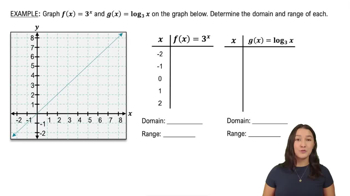
Graphing Logarithmic Functions

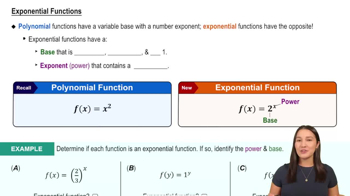
Exponential Functions and Their Properties

Exponential functions have the form f(x) = a^(x), where the variable is in the exponent. They are one-to-one and always positive, which ensures the existence of an inverse. Understanding their behavior, such as growth and domain restrictions, is essential for finding inverses.
추천 영상:
6:13
Exponential Functions

Domain and Range of Functions and Their Inverses

The domain is the set of all possible inputs, and the range is the set of all possible outputs of a function. For inverse functions, the domain and range swap roles compared to the original function. Identifying these sets is crucial for correctly defining ƒ⁻¹(x).
추천 영상:
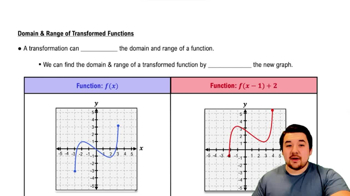
4:22
Domain & Range of Transformed Functions