Ch. 4 - Inverse, Exponential, and Logarithmic Functions
Lial - College Algebra 13th Edition
Lial13th EditionCollege AlgebraISBN: 9780136881063당신이 사용하는 게 아니라요?교과서 변경
5장, 문제 114

Write an equation for the inverse function of each one-to-one function given. ƒ(x) = 4x+2

검증된 단계별 안내
1
Start with the given function: \(f(x) = 4^{x} + 2\).
To find the inverse function, first replace \(f(x)\) with \(y\): \(y = 4^{x} + 2\).
Swap the variables \(x\) and \(y\) to reflect the inverse relationship: \(x = 4^{y} + 2\).
Isolate the exponential term by subtracting 2 from both sides: \(x - 2 = 4^{y}\).
Take the logarithm base 4 of both sides to solve for \(y\): \(y = \log_{4}(x - 2)\), which gives the inverse function \(f^{-1}(x) = \log_{4}(x - 2)\).

비슷한 문제에 대한 검증된 영상 답변:

이 영상 해법은 위 문제에 도움이 된다고 튜터들이 추천한 것입니다.
영상 길이:
3m
도움이 되었나요?

주요 개념

질문에 올바르게 답하기 위해 반드시 이해해야 하는 핵심 개념들은 다음과 같습니다.

One-to-One Functions

A one-to-one function is a function where each output corresponds to exactly one input, ensuring it has an inverse. This property is essential because only one-to-one functions have inverses that are also functions. Verifying this helps confirm that the inverse function exists.
추천 영상:
4:07
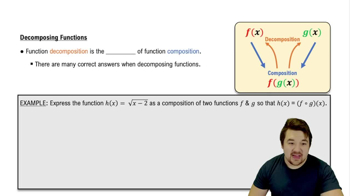
Decomposition of Functions

Inverse Functions

An inverse function reverses the effect of the original function, swapping inputs and outputs. To find the inverse, you replace f(x) with y, interchange x and y, and then solve for y. The inverse function essentially 'undoes' the original function's operation.
추천 영상:
4:30
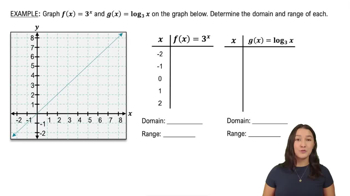
Graphing Logarithmic Functions

Exponential and Logarithmic Functions

Since the given function involves an exponential expression (4^(x+2)), its inverse will involve logarithms. Understanding that logarithms are the inverses of exponential functions is crucial for solving for the inverse function. Specifically, the inverse uses the logarithm base 4 to isolate the variable.
추천 영상:
5:26
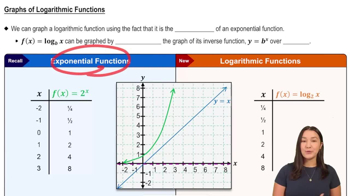
Graphs of Logarithmic Functions