Ch. 4 - Inverse, Exponential, and Logarithmic Functions
Lial - College Algebra 13th Edition
Lial13th EditionCollege AlgebraISBN: 9780136881063당신이 사용하는 게 아니라요?교과서 변경
5장, 문제 112

Write an equation for the inverse function of each one-to-one function given. ƒ(x) = (1/3)x

검증된 단계별 안내
1
Start with the given function: \(f(x) = \left(\frac{1}{3}\right)^x\).
To find the inverse function, first replace \(f(x)\) with \(y\): \(y = \left(\frac{1}{3}\right)^x\).
Swap the variables \(x\) and \(y\) to get the inverse relation: \(x = \left(\frac{1}{3}\right)^y\).
To solve for \(y\), take the logarithm of both sides. You can use the natural logarithm or logarithm base 10: \(\log\left(x\right) = \log\left(\left(\frac{1}{3}\right)^y\right)\).
Use the logarithm power rule to bring down the exponent: \(\log(x) = y \cdot \log\left(\frac{1}{3}\right)\). Then solve for \(y\): \(y = \frac{\log(x)}{\log\left(\frac{1}{3}\right)}\).

비슷한 문제에 대한 검증된 영상 답변:

이 영상 해법은 위 문제에 도움이 된다고 튜터들이 추천한 것입니다.
영상 길이:
3m
도움이 되었나요?

주요 개념

질문에 올바르게 답하기 위해 반드시 이해해야 하는 핵심 개념들은 다음과 같습니다.

One-to-One Functions

A one-to-one function is a function where each output corresponds to exactly one input, ensuring it has an inverse. This means no two different inputs produce the same output, which is essential for the inverse function to exist.
추천 영상:
4:07
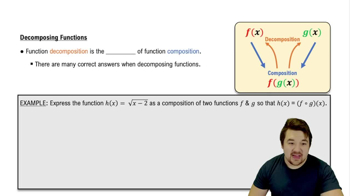
Decomposition of Functions

Inverse Functions

The inverse of a function reverses the roles of inputs and outputs, effectively 'undoing' the original function. For a function f(x), its inverse f⁻¹(x) satisfies f(f⁻¹(x)) = x and f⁻¹(f(x)) = x.
추천 영상:
4:30
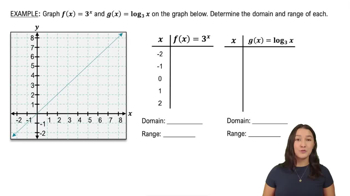
Graphing Logarithmic Functions

Exponential and Logarithmic Functions

Exponential functions like f(x) = (1/3)^x have inverses that are logarithmic functions. To find the inverse, you rewrite the equation in logarithmic form, using the base of the exponential to solve for x.
추천 영상:
5:26
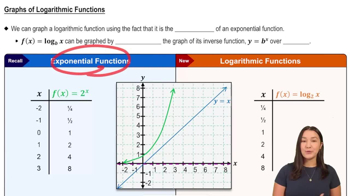
Graphs of Logarithmic Functions