13. Liquids, Solids & Intermolecular Forces
Heating and Cooling Curves
13. Liquids, Solids & Intermolecular Forces
Heating and Cooling Curves
 03:52
03:52

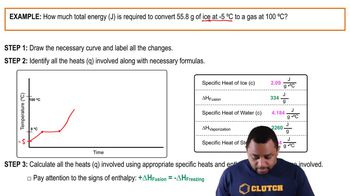
총 5개 중 5개 비디오 표시
추가 2 창작자들.
다른 창작자들과 함께 배우세요
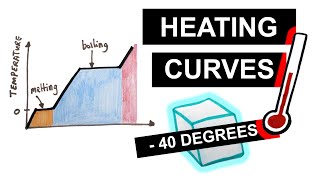

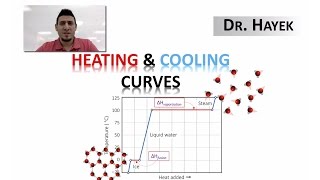

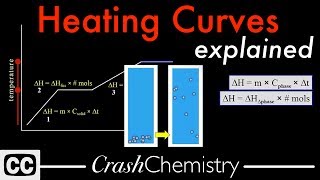



총 5개 중 5개 비디오 표시
이 주제를 연습하세요
- 객관식
How much energy (kJ) is required to convert a 76.4 g acetone (MM = 58.08 g/mol) as a liquid at -30°C to a solid at -115.0°C?
2278views3rank5comments - 객관식
If 53.2kJ of heat are added to a 15.5 g ice cube at - 5.00 oC, what will be the resulting state and temperature of the substance?
4535views10rank7comments - 객관식Calculate the volume (mL) of acetone, C3 H6 O, (density = 0.786 g/mL) that can be vaporized at its normal boiling point with 345 kJ of heat. ΔHvap for acetone is 29.1 kJ/mol.1628views
- 객관식Determine the vapor pressure (atm) of rubbing alcohol (isopropanol) at 20.0℃. The normal boiling point of isopropanol is 82.3℃ and the heat of vaporization (ΔHvap) is 39.9 kJ/mol.1433views
- 미해결 질문
How much energy is released when 42.5 g of water freezes?
852views - 미해결 질문
What quantity of heat, in kj, is required to convert 50.0 g of ethanol (C₂H₅OH) at 23.0°C to a vapor at 78.3°C (its boiling point)? (specific heat capacity of ethanol = 2.46 J/g • c; ∆Hvap = 39.3 kJ/mol)
1517views - 미해결 질문
Which is the process by which a gas changes to a solid: deposition, evaporation, freezing, or sublimation?
816views - 미해결 질문
What are greenhouse gases? How does carbon dioxide enter the atmosphere? (Site 1)
755views