뒤로
뒤로CHEM 131 Chapter 10: Chemical Bonding I: The Lewis Model – Structured Study Notes
스터디 가이드 - 스마트 노트
 자료에 맞춘 맞춤형 노트, 핵심 정의, 예시, 맥락을 확장해 제공합니다.
Chemical Bonding I: The Lewis Model
Structure Determines Properties
The physical and chemical properties of substances are determined by the types of atoms present and the way they are bonded together. The arrangement of atoms and the nature of their bonds influence molecular shape, polarity, reactivity, and interactions with other molecules.
Valence Electrons and Bonding
Role of Valence Electrons
Valence electrons are the outermost electrons of an atom and are held most loosely.
These electrons are primarily involved in chemical bonding, either by being transferred or shared between atoms.
The number of valence electrons determines an element's chemical reactivity and the types of bonds it can form.
Why Do Atoms Bond?
Potential Energy and Bond Formation
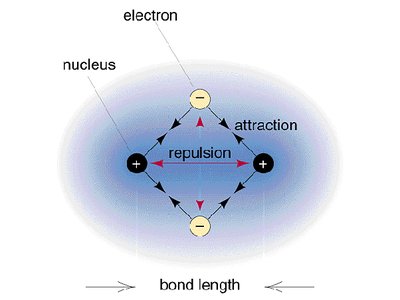
Atoms bond to lower the potential energy between the charged particles (nuclei and electrons) that compose them.
Bond formation involves a balance between attractive (nucleus-electron) and repulsive (nucleus-nucleus, electron-electron) forces.
Major bond theories include: Lewis Bond Theory, VSEPR, Valence Bond Theory, and Molecular Orbital (MO) Theory.
Types of Bonds
Classification by Atom Types
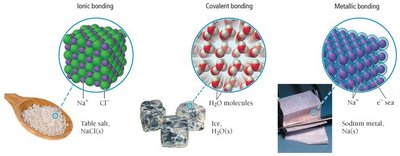
Ionic bonds: Formed between metals and nonmetals; involve the transfer of electrons.
Covalent bonds: Formed between nonmetals; involve the sharing of electrons.
Metallic bonds: Formed between metals; involve pooling of electrons in a 'sea' of electrons.
Bond Characteristics: Polarity
Electronegativity and Dipole Moments
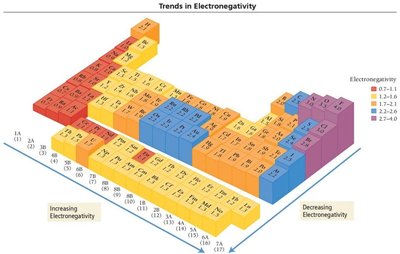
Electronegativity (EN) is the ability of an atom to attract bonding electrons to itself.
EN values range from 0 to 4; fluorine (F) is the most electronegative, francium (Fr) the least.
The dipole moment () is a quantitative measure of bond polarity: , where is the magnitude of the partial charges and is the distance between them.
Percent ionic character quantifies the degree to which a bond is ionic versus covalent.
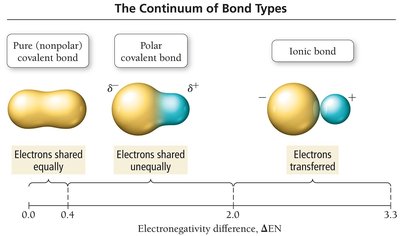
Bond Type and Electronegativity Difference
Pure covalent (nonpolar):
Nonpolar covalent: to
Polar covalent: to
Ionic:
Dipole Moments and Bond Polarity
A dipole is a molecule with a positive and a negative end.
The larger the difference in electronegativity, the more polar the bond and the larger the dipole moment.
Measured in Debyes (D).
Percent Ionic Character
Calculated as:
Percent ionic character increases with electronegativity difference.
Lewis Structures of Molecules and Bonding
The Octet Rule and Lewis Theory
Atoms are most stable when they have eight valence electrons (an octet), except hydrogen and helium, which are stable with two (a duet).
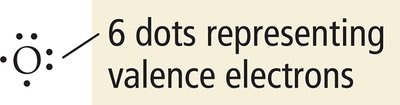
Lewis structures (electron dot structures) represent valence electrons as dots around the element symbol.
Lewis theory predicts molecular shapes, properties, and interactions.
Drawing Lewis Structures for Atoms
Dots are placed around the element symbol to represent valence electrons.
First two dots are paired (s orbital), then one dot per side for p electrons, then pairing remaining p electrons.

Lewis Theory and Ionic Bonding
Electron Transfer and Lattice Energy
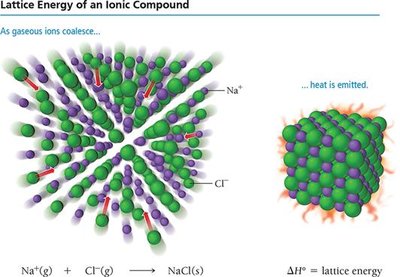
Lewis symbols can show the transfer of electrons from metals to nonmetals, forming ions that attract each other to create ionic bonds.
Lattice energy is the energy released when gaseous ions form an ionic solid.
Lattice energy increases with higher ion charge and decreases with larger ion size.
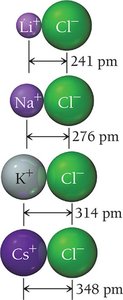
Properties of Ionic Compounds
Predictions and Observations
High melting points (usually >300°C).
Brittle solids that shatter when struck.
Conduct electricity in the liquid state or when dissolved in water, but not as solids.
Many are soluble in water; their solutions conduct electricity well.
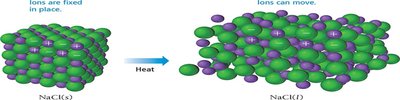
Writing Lewis Structures for Molecular Compounds
Stepwise Procedure
Write the correct skeletal structure (least electronegative atom usually central).
Sum all valence electrons in the molecule or ion.
Connect atoms with single bonds.
Distribute remaining electrons to terminal atoms to complete octets (or duets for H).
If any atom lacks an octet, form double or triple bonds as needed (C, O, N, S, P can double bond; C, O, N, S can triple bond).
Resonance Structures
Delocalization and Resonance Hybrids
Some molecules have more than one valid Lewis structure differing only in electron placement; these are resonance structures.
The actual molecule is a resonance hybrid, a blend of all resonance forms.
Delocalization of charge stabilizes the molecule.
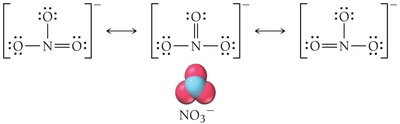
Formal Charge
Calculating and Using Formal Charge
Formal charge (FC) helps distinguish between competing Lewis structures.
Formula:
Sum of all FCs in a neutral molecule must be zero; in an ion, it must equal the ion's charge.
Best structures have the smallest and fewest formal charges, with negative FC on the most electronegative atom.
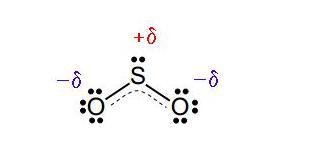
Exceptions to the Octet Rule
Expanded Octets, Odd-Electron Species, and Incomplete Octets
Elements in the third period and beyond (e.g., Xe, As) can have expanded octets.
Odd-electron species (free radicals) cannot satisfy the octet rule (e.g., NO, NO2).
Some elements (e.g., B) are stable with fewer than eight electrons.
Bond Properties: Energies and Lengths
Bond Energy
Bond energy is the energy required to break one mole of a bond in the gas phase.
Stronger bonds have higher bond energies; more shared electrons (double, triple bonds) mean stronger bonds.
Bond strength decreases down a group and increases across a period.
Bond Length
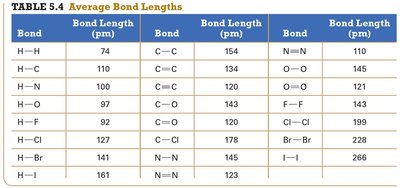
Bond length is the distance between the nuclei of bonded atoms.
Shorter bonds are generally stronger; bond length increases with larger atoms and fewer shared electrons.
Average bond lengths are used for comparison across similar bonds in different molecules.