
Ch.10 - Gases
Brown - Chemistry: The Central Science 14th Edition
Brown14th EditionChemistry: The Central ScienceISBN: 9780134414232당신이 사용하는 게 아니라요?교과서 변경
10장, 문제 92

Based on their respective van der Waals constants ( Table 10.3), is Ar or CO2 expected to behave more nearly like an ideal gas at high pressures?

검증된 단계별 안내
1
insert step 1> Identify the van der Waals equation, which is an adjustment of the ideal gas law to account for the volume occupied by gas molecules and the intermolecular forces between them. The equation is: \( \left( P + \frac{an^2}{V^2} \right)(V - nb) = nRT \), where \( a \) and \( b \) are the van der Waals constants.
insert step 2> Understand that the constant \( a \) accounts for the attractive forces between molecules. A smaller \( a \) value indicates weaker intermolecular forces, making the gas behave more ideally.
insert step 3> Recognize that the constant \( b \) accounts for the volume occupied by the gas molecules themselves. A smaller \( b \) value suggests that the gas molecules occupy less volume, making the gas behave more ideally.
insert step 4> Compare the van der Waals constants \( a \) and \( b \) for Ar and CO2 from Table 10.3. Determine which gas has smaller values for both constants, as this gas will behave more like an ideal gas at high pressures.
insert step 5> Conclude which gas, Ar or CO2, is expected to behave more nearly like an ideal gas at high pressures based on the comparison of their van der Waals constants.

비슷한 문제에 대한 검증된 영상 답변:

이 영상 해법은 위 문제에 도움이 된다고 튜터들이 추천한 것입니다.
영상 길이:
1m
도움이 되었나요?

주요 개념

질문에 올바르게 답하기 위해 반드시 이해해야 하는 핵심 개념들은 다음과 같습니다.

Ideal Gas Law

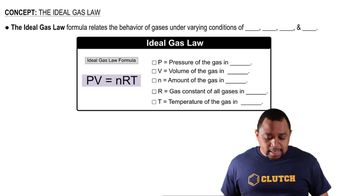
The Ideal Gas Law describes the behavior of ideal gases through the equation PV=nRT, where P is pressure, V is volume, n is the number of moles, R is the ideal gas constant, and T is temperature. Ideal gases are assumed to have no intermolecular forces and occupy no volume, making them behave predictably under various conditions. Understanding this law is crucial for comparing real gases to ideal behavior, especially at high pressures.
추천 영상:
가이드 코스
01:15
Ideal Gas Law Formula

Van der Waals Equation

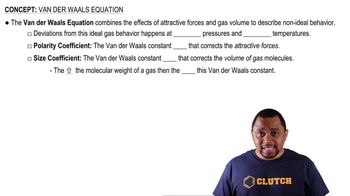
The Van der Waals equation modifies the Ideal Gas Law to account for the volume occupied by gas molecules and the attractive forces between them. It introduces two constants, a and b, which are specific to each gas and reflect the strength of intermolecular forces and the size of the molecules, respectively. This equation helps predict how real gases deviate from ideal behavior, particularly under high pressure and low temperature.
추천 영상:
가이드 코스
01:40
Van der Waals Equation

Intermolecular Forces

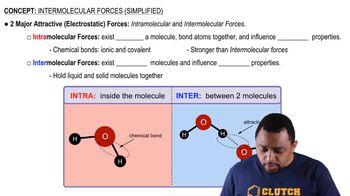
Intermolecular forces are the attractive or repulsive forces between molecules that influence their physical properties and behavior. In the context of gases, stronger intermolecular forces can lead to greater deviations from ideal gas behavior, especially at high pressures where molecules are closer together. Understanding these forces is essential for predicting whether a gas like Ar or CO2 will behave more ideally under specific conditions.
추천 영상:
가이드 코스
01:59
Intermolecular vs Intramolecular Forces