
Ch.10 - Gases
Brown - Chemistry: The Central Science 14th Edition
Brown14th EditionChemistry: The Central ScienceISBN: 9780134414232당신이 사용하는 게 아니라요?교과서 변경
10장, 문제 96

Table 10.3 shows that the van der Waals b parameter has units of L/mol. This means that we can calculate the sizes of atoms or molecules from the b parameter. Refer back to the discussion in Section 7.3. Is the van der Waals radius we calculate from the b parameter of Table 10.3 more closely associated with the bonding or nonbonding atomic radius discussed there? Explain.

검증된 단계별 안내
1
Identify the van der Waals b parameter, which accounts for the volume occupied by gas molecules and is expressed in units of L/mol.
Understand that the van der Waals b parameter is related to the size of the molecules, as it represents the excluded volume per mole of molecules.
Recall that the van der Waals radius is a measure of the size of an atom or molecule when it is not bonded to another atom, reflecting the space it occupies due to electron cloud repulsion.
Compare the van der Waals radius with the bonding atomic radius, which is typically smaller because it represents the distance between nuclei in a bonded state, where electron clouds overlap.
Conclude that the van der Waals radius calculated from the b parameter is more closely associated with the nonbonding atomic radius, as it reflects the size of the molecule when not involved in bonding.

비슷한 문제에 대한 검증된 영상 답변:

이 영상 해법은 위 문제에 도움이 된다고 튜터들이 추천한 것입니다.
영상 길이:
1m
도움이 되었나요?

주요 개념

질문에 올바르게 답하기 위해 반드시 이해해야 하는 핵심 개념들은 다음과 같습니다.

van der Waals b parameter

The van der Waals b parameter represents the volume occupied by one mole of particles in a gas, accounting for the finite size of the molecules. It is a crucial factor in the van der Waals equation, which describes real gas behavior by incorporating molecular interactions and sizes. The b parameter helps in estimating the effective size of atoms or molecules, which is essential for understanding intermolecular forces.
추천 영상:
가이드 코스
01:40
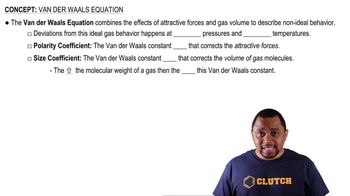
Van der Waals Equation

van der Waals radius

The van der Waals radius is a measure of the size of an atom or molecule when it is not bonded to another atom. It reflects the distance at which the electron clouds of two nonbonding atoms begin to overlap, indicating the effective size of the atom in a nonbonding context. This radius is important for understanding molecular interactions, particularly in gases and liquids where atoms are not held together by covalent bonds.
추천 영상:
가이드 코스
01:40
Van der Waals Equation

bonding vs. nonbonding atomic radius

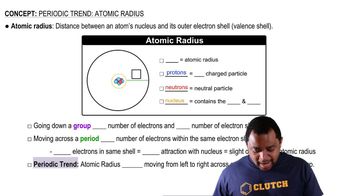
Bonding atomic radius refers to the size of an atom when it is involved in a chemical bond, typically smaller due to the influence of electron sharing or transfer. In contrast, nonbonding atomic radius, such as the van der Waals radius, describes the size of an atom when it is not participating in bonding interactions. Understanding the distinction between these radii is essential for interpreting molecular structures and interactions in various states of matter.
추천 영상: