Ch.10 - Gases
Brown - Chemistry: The Central Science 14th Edition
Brown14th EditionChemistry: The Central ScienceISBN: 9780134414232당신이 사용하는 게 아니라요?교과서 변경
10장, 문제 97

Torricelli, who invented the barometer, used mercury in its construction because mercury has a very high density, which makes it possible to make a more compact barometer than one based on a less dense fluid. Calculate the density of mercury using the observation that the column of mercury is 760 mm high when the atmospheric pressure is 1.01 * 105 Pa. Assume the tube containing the mercury is a cylinder with a constant cross-sectional area.

검증된 단계별 안내
1
Step 1: Understand that the pressure at the base of a fluid column is given by the equation P = ρgh, where P is the pressure, ρ is the density of the fluid, g is the acceleration due to gravity, and h is the height of the fluid column.
Step 2: In this problem, we are given P (atmospheric pressure = 1.01 * 10^5 Pa), g (acceleration due to gravity = 9.8 m/s^2), and h (height of the mercury column = 760 mm = 0.76 m). We are asked to solve for ρ (density of mercury).
Step 3: Rearrange the equation P = ρgh to solve for ρ. The rearranged equation is ρ = P / (gh).
Step 4: Substitute the given values into the rearranged equation. ρ = (1.01 * 10^5 Pa) / (9.8 m/s^2 * 0.76 m).
Step 5: Calculate the density of mercury by performing the division in the equation from step 4. This will give you the density of mercury in kg/m^3.

비슷한 문제에 대한 검증된 영상 답변:

이 영상 해법은 위 문제에 도움이 된다고 튜터들이 추천한 것입니다.
영상 길이:
4m
도움이 되었나요?

주요 개념

질문에 올바르게 답하기 위해 반드시 이해해야 하는 핵심 개념들은 다음과 같습니다.

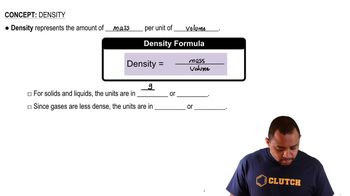
Density

Density is defined as mass per unit volume, typically expressed in grams per cubic centimeter (g/cm³) or kilograms per cubic meter (kg/m³). It is a fundamental property of materials that influences how substances behave under various conditions. In the context of the barometer, the high density of mercury allows for a shorter column height compared to less dense fluids, making it practical for measuring atmospheric pressure.
추천 영상:
가이드 코스
01:56
Density Concepts

Atmospheric Pressure

Atmospheric pressure is the force exerted by the weight of the air above a given point, measured in pascals (Pa) or millimeters of mercury (mmHg). At sea level, standard atmospheric pressure is approximately 101,325 Pa, which corresponds to a mercury column height of 760 mm. This relationship is crucial for understanding how barometers function, as they measure changes in atmospheric pressure by the height of the mercury column.
추천 영상:
가이드 코스
02:09
Total Pressure Example

Hydrostatic Pressure

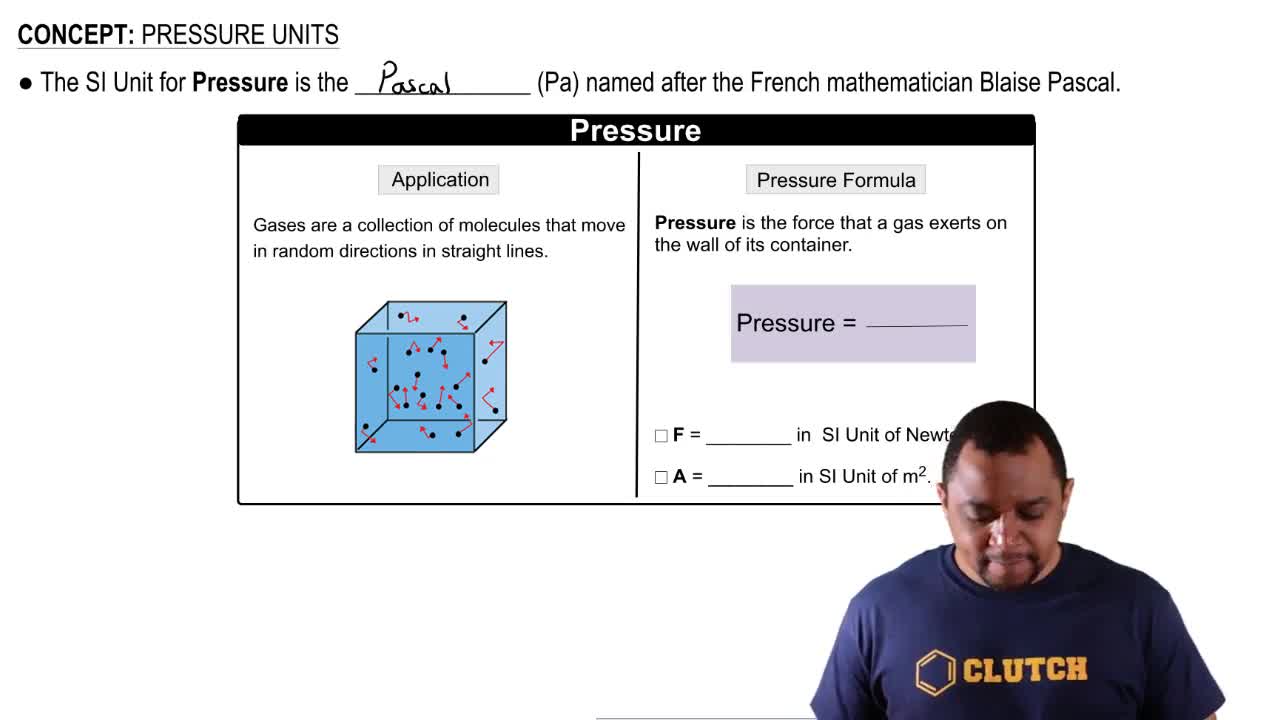
Hydrostatic pressure is the pressure exerted by a fluid at equilibrium due to the force of gravity. It is calculated using the formula P = ρgh, where P is the pressure, ρ is the fluid density, g is the acceleration due to gravity, and h is the height of the fluid column. In the case of the barometer, the hydrostatic pressure of the mercury column balances the atmospheric pressure, allowing for the calculation of mercury's density based on the height of the column.
추천 영상:
관련 실천
교과서 질문

Calculate the pressure that CCl4 will exert at 80 °C if 1.00 mol occupies 33.3 L, assuming that (a) CCl4 obeys the ideal-gas equation (b) CCl4 obeys the van der Waals equation. (Values for the van der Waals constants are given in Table 10.3.)

631
views
교과서 질문

Calculate the pressure that CCl4 will exert at 80 °C if 1.00 mol occupies 33.3 L, assuming that (c) Which would you expect to deviate more from ideal behavior under these conditions, Cl2 or CCl4? Explain.

교과서 질문

Carbon dioxide, which is recognized as the major contributor to global warming as a 'greenhouse gas,' is formed when fossil fuels are combusted, as in electrical power plants fueled by coal, oil, or natural gas. One potential way to reduce the amount of CO2 added to the atmosphere is to store it as a compressed gas in underground formations. Consider a 1000-megawatt coal-fired power plant that produces about 6×10⁶ tons of CO2 per year. (a) Assuming ideal-gas behavior, 101.3 kPa, and 27 °C, calculate the volume of CO2 produced by this power plant.

970
views
교과서 질문

A gas bubble with a volume of 1.0 mm3 originates at the bottom of a lake where the pressure is 3.0 atm. Calculate its volume when the bubble reaches the surface of the lake where the pressure is 730 torr, assuming that the temperature does not change.

691
views
교과서 질문

Table 10.3 shows that the van der Waals b parameter has units of L/mol. This means that we can calculate the sizes of atoms or molecules from the b parameter. Refer back to the discussion in Section 7.3. Is the van der Waals radius we calculate from the b parameter of Table 10.3 more closely associated with the bonding or nonbonding atomic radius discussed there? Explain.

1152
views