
Ch.11 - Liquids and Intermolecular Forces
Brown - Chemistry: The Central Science 14th Edition
Brown14th EditionChemistry: The Central ScienceISBN: 9780134414232당신이 사용하는 게 아니라요?교과서 변경
11장, 문제 57

What is the significance of the critical point in a phase diagram? Why does the line that separates the gas and liquid phases end at the critical point?

검증된 단계별 안내
1
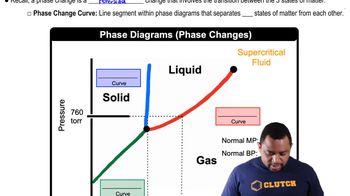
The critical point in a phase diagram represents the end of the line that separates the liquid and gas phases. At this point, the properties of the liquid and gas phases become indistinguishable.
Above the critical temperature and critical pressure, the substance exists as a supercritical fluid, where it exhibits properties of both a liquid and a gas.
The line that separates the gas and liquid phases, known as the vapor-liquid equilibrium line, ends at the critical point because beyond this point, there is no distinct phase transition between liquid and gas.
At the critical point, the density of the liquid phase equals the density of the gas phase, leading to the disappearance of the meniscus between the two phases.
Understanding the critical point is important for applications such as supercritical fluid extraction, where substances are used in their supercritical state to achieve efficient separation processes.

주요 개념

질문에 올바르게 답하기 위해 반드시 이해해야 하는 핵심 개념들은 다음과 같습니다.

Phase Diagram

A phase diagram is a graphical representation that shows the phases of a substance (solid, liquid, gas) as a function of temperature and pressure. It illustrates the conditions under which distinct phases coexist and helps predict the state of a substance at various temperatures and pressures. The critical point is a key feature on this diagram, marking the end of the liquid-gas phase boundary.
추천 영상:
가이드 코스
03:22
Phase Changes in Diagrams

Critical Point

The critical point is the temperature and pressure at which the properties of a liquid and gas become indistinguishable. At this point, the substance reaches a state known as a supercritical fluid, where it can diffuse through solids like a gas and dissolve materials like a liquid. This unique state has significant implications in various scientific and industrial applications.
추천 영상:
가이드 코스
03:05
Boiling Point Elevation

Phase Transition

A phase transition refers to the transformation of a substance from one phase to another, such as from liquid to gas. The line that separates the gas and liquid phases in a phase diagram represents the conditions under which these two phases can coexist. At the critical point, this line ends because beyond this point, the distinction between liquid and gas disappears, leading to the formation of a supercritical fluid.
추천 영상:
가이드 코스
03:22
Phase Changes in Diagrams