
Ch.11 - Liquids and Intermolecular Forces
Brown - Chemistry: The Central Science 14th Edition
Brown14th EditionChemistry: The Central ScienceISBN: 9780134414232당신이 사용하는 게 아니라요?교과서 변경
11장, 문제 60a

Referring to Figure 11.29, describe the phase changes (and the temperatures at which they occur) when CO2 is heated from -80 to -20°C at (a) a constant pressure of 3 atm,

검증된 단계별 안내
1
Identify the phase diagram for CO2, which shows the phases (solid, liquid, gas) and the lines representing phase changes at different pressures and temperatures.
Locate the pressure of 3 atm on the phase diagram. This will help determine the phase changes CO2 undergoes as it is heated.
Trace a horizontal line at 3 atm from -80°C to -20°C on the phase diagram to observe the phase changes.
Note the temperatures at which the line crosses the phase boundaries. These are the temperatures at which phase changes occur.
Describe the phase changes: starting from solid CO2 (dry ice) at -80°C, identify if it sublimates directly to gas or if it passes through a liquid phase, based on the phase diagram at 3 atm.

비슷한 문제에 대한 검증된 영상 답변:

이 영상 해법은 위 문제에 도움이 된다고 튜터들이 추천한 것입니다.
영상 길이:
1m
도움이 되었나요?

주요 개념

질문에 올바르게 답하기 위해 반드시 이해해야 하는 핵심 개념들은 다음과 같습니다.

Phase Changes

Phase changes refer to the transitions between different states of matter, such as solid, liquid, and gas. In the context of CO2, these changes include sublimation (solid to gas) and deposition (gas to solid). Understanding these transitions is crucial for analyzing how CO2 behaves under varying temperature and pressure conditions.
추천 영상:
가이드 코스
01:46
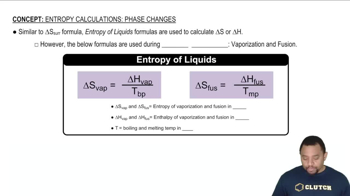
Entropy in Phase Changes

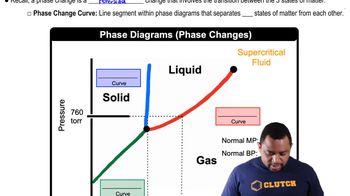
Phase Diagrams

A phase diagram is a graphical representation that shows the phases of a substance at different temperatures and pressures. It helps predict the state of a substance under specific conditions. For CO2, the phase diagram indicates the boundaries between solid, liquid, and gas phases, which are essential for determining the phase changes occurring at 3 atm pressure.
추천 영상:
가이드 코스
03:22
Phase Changes in Diagrams

Critical Point

The critical point is the temperature and pressure at which the distinction between liquid and gas phases disappears. For CO2, this point is significant because it defines the conditions under which CO2 can exist as a supercritical fluid. Understanding the critical point is important for predicting the behavior of CO2 when heated from -80 to -20°C at a constant pressure of 3 atm.
추천 영상:
가이드 코스
03:05
Boiling Point Elevation