Ch.11 - Liquids and Intermolecular Forces
Brown - Chemistry: The Central Science 14th Edition
Brown14th EditionChemistry: The Central ScienceISBN: 9780134414232당신이 사용하는 게 아니라요?교과서 변경
11장, 문제 73

As the intermolecular attractive forces between molecules increase in magnitude, do you expect the heat of vaporization to increase or decrease in magnitude?

검증된 단계별 안내
1
Understand that the heat of vaporization is the amount of energy required to convert a liquid into a gas at its boiling point.
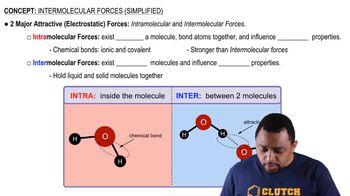
Recognize that intermolecular forces are the forces of attraction between molecules. Stronger intermolecular forces mean that molecules are held together more tightly.
Consider that if the intermolecular forces are strong, more energy will be required to overcome these forces to allow the molecules to escape into the gas phase.
Conclude that as the intermolecular attractive forces increase, the heat of vaporization will also increase because more energy is needed to break these stronger forces.
Summarize that the heat of vaporization is directly related to the strength of the intermolecular forces: stronger forces result in a higher heat of vaporization.

주요 개념

질문에 올바르게 답하기 위해 반드시 이해해야 하는 핵심 개념들은 다음과 같습니다.

Intermolecular Forces

Intermolecular forces are the attractive forces that occur between molecules. These forces include hydrogen bonding, dipole-dipole interactions, and London dispersion forces. The strength of these forces significantly influences the physical properties of substances, including boiling and melting points, as well as heat of vaporization.
추천 영상:
가이드 코스
01:59
Intermolecular vs Intramolecular Forces

Heat of Vaporization

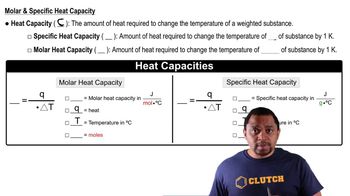
The heat of vaporization is the amount of energy required to convert a unit mass of a liquid into vapor at constant temperature and pressure. It reflects the strength of intermolecular forces; stronger forces require more energy to overcome, resulting in a higher heat of vaporization. This property is crucial for understanding phase changes and energy transfer in chemical processes.
추천 영상:

Phase Changes

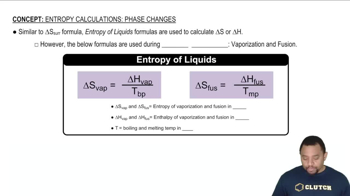
Phase changes refer to the transitions between solid, liquid, and gas states of matter. During these transitions, energy is either absorbed or released, which is directly related to the intermolecular forces present. Understanding phase changes helps explain how temperature and pressure affect the state of a substance, including the relationship between intermolecular forces and heat of vaporization.
추천 영상:
가이드 코스
01:46
Entropy in Phase Changes