
Ch.11 - Liquids and Intermolecular Forces
Brown - Chemistry: The Central Science 14th Edition
Brown14th EditionChemistry: The Central ScienceISBN: 9780134414232당신이 사용하는 게 아니라요?교과서 변경
11장, 문제 29

Look up and compare the normal boiling points and normal melting points of H2O and H2S. Based on these physical properties, which substance has stronger intermolecular forces? What kinds of intermolecular forces exist for each molecule?

검증된 단계별 안내
1
Step 1: Identify the normal boiling and melting points of H2O and H2S. H2O has a boiling point of 100°C and a melting point of 0°C, while H2S has a boiling point of -60°C and a melting point of -85°C.
Step 2: Compare the boiling and melting points of H2O and H2S. Notice that H2O has significantly higher boiling and melting points than H2S.
Step 3: Determine the types of intermolecular forces present in each molecule. H2O exhibits hydrogen bonding, dipole-dipole interactions, and London dispersion forces. H2S primarily exhibits dipole-dipole interactions and London dispersion forces.
Step 4: Analyze the strength of intermolecular forces based on boiling and melting points. Higher boiling and melting points in H2O suggest stronger intermolecular forces compared to H2S.
Step 5: Conclude that H2O has stronger intermolecular forces due to the presence of hydrogen bonding, which is absent in H2S, leading to higher boiling and melting points.

주요 개념

질문에 올바르게 답하기 위해 반드시 이해해야 하는 핵심 개념들은 다음과 같습니다.

Intermolecular Forces

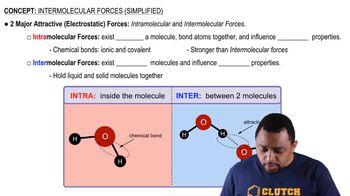
Intermolecular forces are the attractive forces between molecules that influence their physical properties, such as boiling and melting points. The main types include hydrogen bonding, dipole-dipole interactions, and London dispersion forces. Stronger intermolecular forces typically result in higher boiling and melting points, as more energy is required to overcome these attractions.
추천 영상:
가이드 코스
01:59
Intermolecular vs Intramolecular Forces

Hydrogen Bonding

Hydrogen bonding is a specific type of strong dipole-dipole interaction that occurs when hydrogen is bonded to highly electronegative atoms like oxygen, nitrogen, or fluorine. In the case of water (H2O), hydrogen bonds significantly increase its boiling and melting points compared to substances that do not exhibit hydrogen bonding, such as hydrogen sulfide (H2S), which primarily experiences weaker dipole-dipole interactions.
추천 영상:
가이드 코스
01:22
Hydrogenation Reactions

Boiling and Melting Points

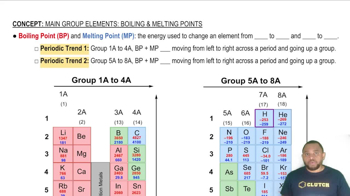
Boiling and melting points are physical properties that indicate the temperatures at which a substance transitions between solid, liquid, and gas phases. These points are influenced by the strength of intermolecular forces; substances with stronger forces will have higher boiling and melting points. Comparing the boiling and melting points of H2O and H2S reveals insights into the relative strength of their intermolecular forces.
추천 영상:
가이드 코스
04:29
Boiling Point and Melting Point
관련 실천
교과서 질문

Ethylene glycol (HOCH2CH2OH), the major substance in antifreeze, has a normal boiling point of 198 °C. By comparison, ethyl alcohol (CH3CH2OH) boils at 78 °C at atmospheric pressure. Ethylene glycol dimethyl ether (CH3OCH2CH2OCH3) has a normal boiling point of 83 °C, and ethyl methyl ether (CH3CH2OCH3) has a nomral boiling point of 11 °C. (b) What are the major factors responsible for the difference in boiling points of the two ethers?

교과서 질문

(b) What is the relationship between viscosity and temperature?

392
views
교과서 질문

Ethylene glycol (HOCH2CH2OH), the major substance in antifreeze, has a normal boiling point of 198 °C. By comparison, ethyl alcohol (CH3CH2OH) boils at 78 °C at atmospheric pressure. Ethylene glycol dimethyl ether (CH3OCH2CH2OCH3) has a normal boiling point of 83 °C, and ethyl methyl ether (CH3CH2OCH3) has a nomral boiling point of 11 °C. (a) Explain why replacement of a hydrogen on the oxygen by a CH3 group generally results in a lower boiling point.

2179
views
교과서 질문

A number of salts containing the tetrahedral polyatomic anion, BF4-, are ionic liquids, whereas salts containing the somewhat larger tetrahedral ion SO42- do not form ionic liquids. Explain this observation.

682
views
교과서 질문

The generic structural formula for a 1-alkyl-3-methylimid- azolium cation is where R is a -CH2(CH2)nCH3 alkyl group. The melting points of the salts that form between 1-alkyl-3-methylimidazolium cation and the PF6- anion are as follows: R = CH2CH3 (m.p. = 60 °C), R = CH2CH2CH3 (m.p. = 40 °C), r = CH2CH2CH2CH3 (m.p. = 10 °C), and R = CH2CH2CH2CH2CH2CH3 (m.p. = -61 °C). Why does the melting point decrease as the length of alkyl group increases?

387
views
교과서 질문

Based on the type or types of intermolecular forces, predict the substance in each pair that has the higher boiling point: (a) propane (C3H8) or n-butane (C4H10) (b) diethyl ether (CH3CH2OCH2CH3) or 1-butanol (CH3CH2CH2CH2OH) (c) sulfur dioxide (SO2) or sulfur trioxide (SO3) (d) phosgene (Cl2CO) or formaldehyde (H2CO)

1364
views