
Ch.11 - Liquids and Intermolecular Forces
Brown - Chemistry: The Central Science 14th Edition
Brown14th EditionChemistry: The Central ScienceISBN: 9780134414232당신이 사용하는 게 아니라요?교과서 변경
11장, 문제 78a

The table below shows the normal boiling points of benzene and benzene derivatives.
(a) How many of these compounds exhibit dispersion interactions?

검증된 단계별 안내
1
Step 1: Understand that dispersion forces, also known as London dispersion forces or van der Waals forces, are a type of intermolecular force that exist between all molecules, regardless of whether they are polar or nonpolar. These forces are caused by temporary fluctuations in electron distribution within molecules, which create temporary positive and negative charges that attract other molecules.
Step 2: Recognize that all molecules, including benzene and its derivatives, exhibit dispersion interactions. This is because all molecules have electrons that can create temporary charge imbalances.
Step 3: Look at the table of benzene and benzene derivatives. Count the number of compounds listed.
Step 4: Since all compounds exhibit dispersion interactions, the number of compounds that exhibit these interactions is equal to the total number of compounds listed in the table.
Step 5: Therefore, to answer the question, count the total number of compounds in the table. This is the number of compounds that exhibit dispersion interactions.

비슷한 문제에 대한 검증된 영상 답변:

이 영상 해법은 위 문제에 도움이 된다고 튜터들이 추천한 것입니다.
영상 길이:
1m
도움이 되었나요?

주요 개념

질문에 올바르게 답하기 위해 반드시 이해해야 하는 핵심 개념들은 다음과 같습니다.

Dispersion Interactions

Dispersion interactions, also known as London dispersion forces, are weak intermolecular forces that arise from temporary fluctuations in electron density within molecules. These fluctuations create instantaneous dipoles that induce dipoles in neighboring molecules, leading to an attractive force. All molecules, regardless of polarity, exhibit dispersion interactions, but they are particularly significant in nonpolar compounds.
추천 영상:
가이드 코스
03:01
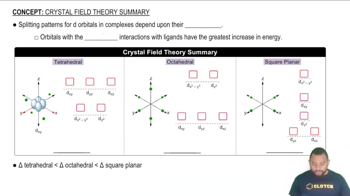
The greatest ligand-orbital interactions result in the greatest increase in energy.

Boiling Point and Intermolecular Forces

The boiling point of a substance is the temperature at which its vapor pressure equals the external pressure, allowing it to transition from liquid to gas. Intermolecular forces, including dispersion interactions, hydrogen bonding, and dipole-dipole interactions, play a crucial role in determining boiling points. Stronger intermolecular forces typically result in higher boiling points, as more energy is required to overcome these attractions.
추천 영상:
가이드 코스
01:59
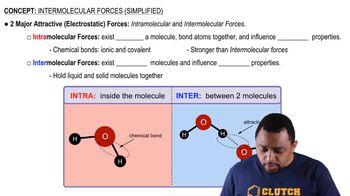
Intermolecular vs Intramolecular Forces

Benzene and Its Derivatives

Benzene is an aromatic hydrocarbon with a stable ring structure, characterized by its delocalized π electrons. Its derivatives are compounds that contain the benzene ring but may have different functional groups attached. The presence of these functional groups can influence the types and strengths of intermolecular forces present, including dispersion interactions, which are relevant for understanding their boiling points.
추천 영상:
가이드 코스
01:13
Benzene Reactions