
Use the normal boiling points propane (C3H8) -42.1 °C butane (C4H10) -0.5 °C pentane (C5H12) 36.1 °C hexane (C6H14) 68.7 °C heptane (C7H16) 98.4 °C to estimate the normal boiling point of octane (C8H18). Explain the trend in the boiling points.
Ch.11 - Liquids and Intermolecular Forces
11장, 문제 78e
The table below shows the normal boiling points of benzene and benzene derivatives. (e) Why is the boiling point of phenol the highest of all?
검증된 단계별 안내1
Identify the compounds in the table: benzene and its derivatives, including phenol.
Understand that boiling point is influenced by intermolecular forces: stronger forces lead to higher boiling points.
Recognize that phenol has an -OH group, which allows for hydrogen bonding, a strong intermolecular force.
Compare the intermolecular forces: phenol's hydrogen bonding is stronger than the van der Waals forces in benzene and other derivatives without -OH groups.
Conclude that the presence of hydrogen bonding in phenol results in a higher boiling point compared to other benzene derivatives.

비슷한 문제에 대한 검증된 영상 답변:
이 영상 해법은 위 문제에 도움이 된다고 튜터들이 추천한 것입니다.
영상 길이:
44s도움이 되었나요?
주요 개념
질문에 올바르게 답하기 위해 반드시 이해해야 하는 핵심 개념들은 다음과 같습니다.
Hydrogen Bonding
Hydrogen bonding is a strong type of dipole-dipole interaction that occurs when hydrogen is bonded to highly electronegative atoms like oxygen or nitrogen. In phenol, the hydroxyl (-OH) group can form hydrogen bonds with other phenol molecules, leading to increased intermolecular attractions. This results in a higher boiling point compared to compounds that do not exhibit hydrogen bonding.
추천 영상:
가이드 코스
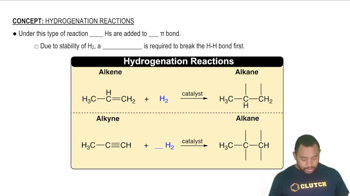
Hydrogenation Reactions
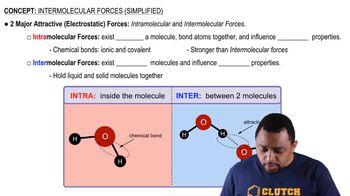
Intermolecular Forces
Intermolecular forces are the forces of attraction or repulsion between molecules. They include hydrogen bonds, dipole-dipole interactions, and London dispersion forces. The strength and type of these forces significantly influence the physical properties of substances, such as boiling points. Phenol's ability to engage in strong hydrogen bonding elevates its boiling point relative to other benzene derivatives.
추천 영상:
가이드 코스
Intermolecular vs Intramolecular Forces
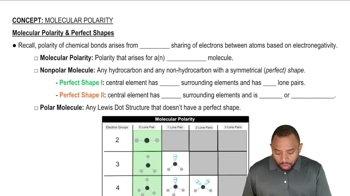
Molecular Structure and Polarity
The molecular structure and polarity of a compound play crucial roles in determining its boiling point. Phenol has a polar -OH group, which contributes to its overall polarity. This polarity enhances the strength of intermolecular forces, particularly hydrogen bonding, making phenol's boiling point higher than that of non-polar or less polar benzene derivatives.
추천 영상:
가이드 코스
Molecular Polarity
관련 실천
교과서 질문
2187
views
교과서 질문
Suppose you have two colorless molecular liquids, one boiling at - 84 °C, the other at 34 °C, and both at atmospheric 6 pressure. Which of the following statements is correct? For each statement that is not correct, modify the statement so that it is correct. (e) At - 84 °C both liquids have vapor pressures of 760 mm Hg.
478
views
교과서 질문
Two isomers of the planar compound 1,2-dichloroethylene are shown here.
(a) Which of the two isomers will have the stronger dipole– dipole forces?
585
views
교과서 질문
The table below shows the normal boiling points of benzene and benzene derivatives.
(a) How many of these compounds exhibit dispersion interactions?
347
views
교과서 질문
(a) When you exercise vigorously, you sweat. How does this help your body cool?
436
views
