Which would you expect to be the more ductile element, (a) Ag or Mo? (b) Zn or Si? In each case explain your reasoning.
Ch.12 - Solids and Modern Materials
12장, 문제 55
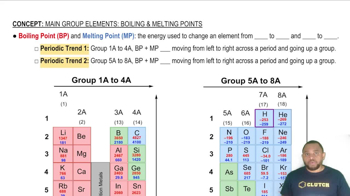
Arrange the following metals in increasing order of expected melting points: Mo, Zr, Y, Nb. Explain this trend in melting points.
검증된 단계별 안내1
Step 1: Understand the concept of melting points in metals. Melting points are influenced by the strength of metallic bonds, which depend on factors such as atomic size, electron configuration, and the number of valence electrons.
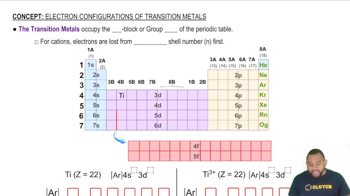
Step 2: Consider the position of each metal in the periodic table. Molybdenum (Mo), Zirconium (Zr), Yttrium (Y), and Niobium (Nb) are all transition metals, and their properties can be compared based on their group and period.
Step 3: Analyze the electron configuration of each metal. Transition metals have partially filled d-orbitals, and the number of electrons in these orbitals can affect the strength of metallic bonding.
Step 4: Compare the atomic sizes of the metals. Generally, smaller atoms can pack more closely together, leading to stronger metallic bonds and higher melting points.
Step 5: Arrange the metals based on the analysis of their atomic size, electron configuration, and position in the periodic table to determine the trend in melting points.
주요 개념
질문에 올바르게 답하기 위해 반드시 이해해야 하는 핵심 개념들은 다음과 같습니다.
Melting Point Trends in Metals
The melting point of metals is influenced by their atomic structure and bonding. Generally, metals with stronger metallic bonds, which arise from a higher number of delocalized electrons, exhibit higher melting points. Transition metals, like those in the question, often have varying melting points due to differences in their electron configurations and crystal lattice structures.
추천 영상:
가이드 코스
Boiling Point and Melting Point
Transition Metals
Transition metals are elements found in the d-block of the periodic table, characterized by their ability to form variable oxidation states and complex ions. They typically have high melting points due to the presence of d-electrons that contribute to metallic bonding. The specific arrangement of these d-electrons can significantly affect the melting point of each metal.
추천 영상:
가이드 코스
Transition Metals
Periodic Trends
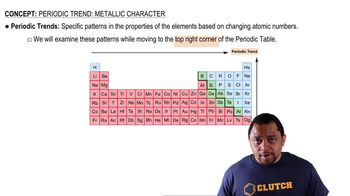
Periodic trends refer to the predictable patterns observed in the properties of elements as you move across or down the periodic table. For melting points, as you move from left to right across a period, melting points generally increase due to stronger bonding. However, this trend can vary among groups, especially in transition metals, where factors like atomic size and electron configuration play critical roles.
추천 영상:
가이드 코스
Periodic Trends
관련 실천
교과서 질문
563
views
교과서 질문
Repeat Exercise 12.51 for a linear chain of eight lithium atoms. (f) How does the HOMO–LUMO energy gap for this case compare to that of the four-atom case?
332
views
교과서 질문
Which of the following statements does not follow from the fact that the alkali metals have relatively weak metal–metal bonding? (a) The alkali metals are less dense than other metals. (b) The alkali metals are soft enough to be cut with a knife. (c) The alkali metals are more reactive than other metals. (d) The alkali metals have higher melting points than other metals. (e) The alkali metals have low ionization energies.
674
views
교과서 질문
The unit cell of a compound containing Co and O has a unit
cell shown below. The Co atoms are on the corners, and the O
atoms are completely within the unit cell. What is the empirical
formula of this compound? What is the oxidation state of
the metal?
668
views
교과서 질문
Tausonite, a mineral composed of Sr, O, and Ti, has the cubic unit cell shown in the drawing. (a) What is the empirical formula of this mineral?
756
views
교과서 질문
For each of the following groups, which metal would you
expect to have the highest melting point: (b) rubidium, molybdenum, or indium?
792
views