Silicon is the fundamental component of integrated circuits. Si has the same structure as diamond. (a) Is Si a molecular, metallic, ionic, or covalent-network solid?
Ch.12 - Solids and Modern Materials
12장, 문제 12b
Silicon is the fundamental component of integrated circuits. Si has the same structure as diamond. (b) Silicon readily reacts to form silicon dioxide, SiO2, which is quite hard and is insoluble in water. Is SiO2 most likely a molecular, metallic, ionic, or covalent-network solid?
검증된 단계별 안내1
Identify the types of solids: molecular, metallic, ionic, and covalent-network.
Consider the properties of SiO2: it is hard and insoluble in water.
Recall that molecular solids are typically soft and have low melting points, which does not match SiO2.
Metallic solids are characterized by metallic bonding and conductivity, which does not apply to SiO2.
Covalent-network solids are hard, have high melting points, and are insoluble in water, which matches the properties of SiO2.

비슷한 문제에 대한 검증된 영상 답변:
이 영상 해법은 위 문제에 도움이 된다고 튜터들이 추천한 것입니다.
영상 길이:
50s도움이 되었나요?
주요 개념
질문에 올바르게 답하기 위해 반드시 이해해야 하는 핵심 개념들은 다음과 같습니다.
Types of Solids
Solids can be classified into different categories based on their bonding and structure. Molecular solids consist of molecules held together by intermolecular forces, metallic solids are composed of metal atoms sharing electrons, ionic solids are formed from the electrostatic attraction between ions, and covalent-network solids feature a continuous network of covalent bonds. Understanding these categories helps in predicting the properties of materials.
추천 영상:
가이드 코스
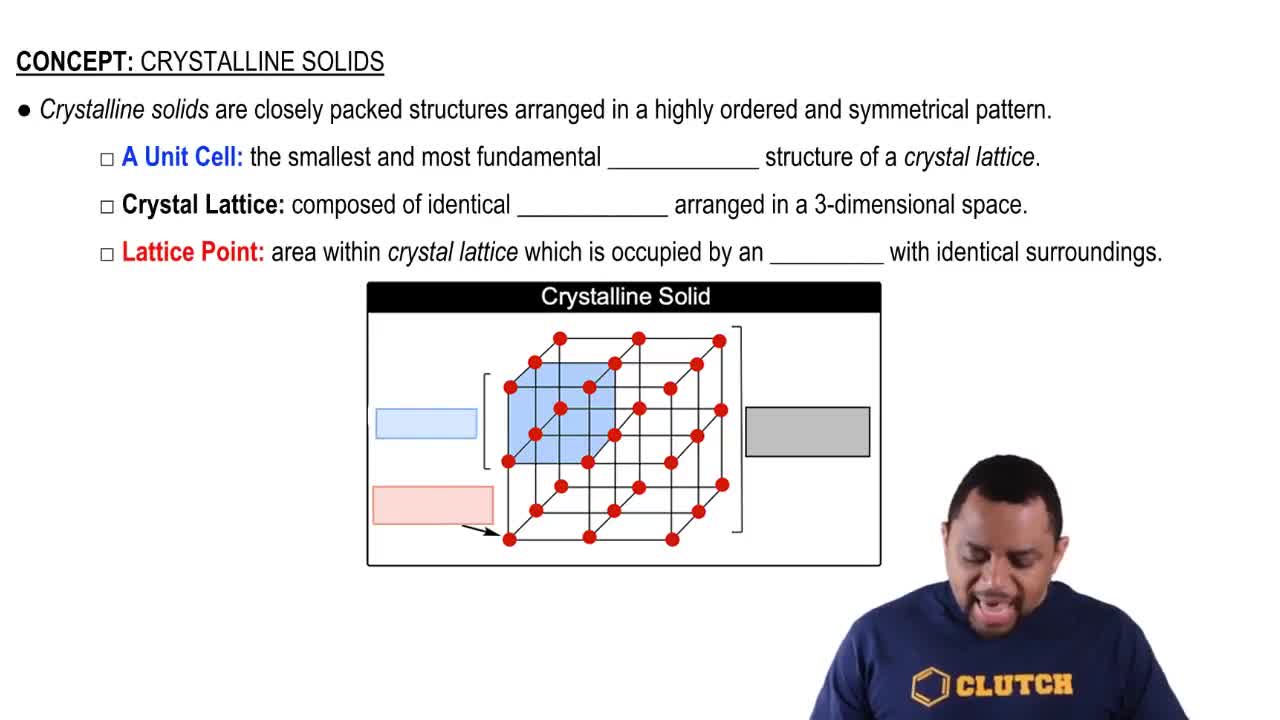
Crystalline Solids Structure
Silicon Dioxide Structure
Silicon dioxide (SiO2) has a three-dimensional network structure where each silicon atom is covalently bonded to four oxygen atoms, and each oxygen atom is bonded to two silicon atoms. This arrangement creates a strong, rigid lattice that contributes to its hardness and insolubility in water. Recognizing this structure is crucial for identifying SiO2 as a covalent-network solid.
추천 영상:
가이드 코스
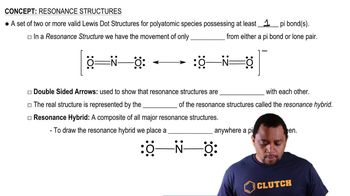
Resonance Structures
Properties of Covalent-Network Solids
Covalent-network solids, like SiO2, exhibit unique properties such as high melting points, hardness, and low electrical conductivity. These properties arise from the strong covalent bonds that extend throughout the material, making them very stable. Understanding these characteristics is essential for determining the classification of SiO2 in the context of solid-state chemistry.
추천 영상:
가이드 코스
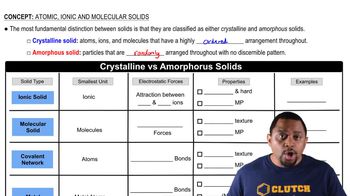
Crystalline vs Amorphous Solids
관련 실천
교과서 질문
354
views
교과서 질문
What kinds of attractive forces exist between particles (atoms, molecules, or ions) in (a) molecular crystals?
1167
views
교과서 질문
Which type (or types) of crystalline solid is characterized by each of the following? (a) High mobility of electrons throughout the solid;
1063
views
교과서 질문
The accompanying image shows photoluminescence from four different samples of CdTe nanocrystals, each embedded in a polymer matrix. The photoluminescence occurs because the samples are being irradiated by a UV light source. The nanocrystals in each vial have different average sizes. The sizes are 4.0, 3.5, 3.2, and 2.8 nm. (a) Which vial contains the 4.0-nm nanocrystals?
268
views
교과서 질문
What kinds of attractive forces exist between particles (atoms, molecules, or ions) in (d) and metallic crystals?
520
views