Silicon is the fundamental component of integrated circuits. Si has the same structure as diamond. (a) Is Si a molecular, metallic, ionic, or covalent-network solid?
Ch.12 - Solids and Modern Materials
12장, 문제 13a
What kinds of attractive forces exist between particles (atoms, molecules, or ions) in (a) molecular crystals?
검증된 단계별 안내1
Identify the type of particles present in molecular crystals: In molecular crystals, the particles are molecules.
Understand the nature of molecular interactions: Molecular crystals are held together primarily by intermolecular forces rather than chemical bonds.
Recognize the types of intermolecular forces: The main types of intermolecular forces include London dispersion forces, dipole-dipole interactions, and hydrogen bonds.
Analyze the strength and characteristics of these forces: London dispersion forces are generally weaker and occur due to temporary dipoles. Dipole-dipole interactions occur between molecules with permanent dipoles. Hydrogen bonds are a stronger type of dipole-dipole interaction that occurs specifically when hydrogen is bonded to a highly electronegative atom like oxygen, nitrogen, or fluorine.
Apply this understanding to molecular crystals: In molecular crystals, the type of intermolecular force present depends on the specific molecules that make up the crystal. For example, ice (a molecular crystal of water) exhibits hydrogen bonding due to the polar nature of water molecules.

비슷한 문제에 대한 검증된 영상 답변:
이 영상 해법은 위 문제에 도움이 된다고 튜터들이 추천한 것입니다.
영상 길이:
1m도움이 되었나요?
주요 개념
질문에 올바르게 답하기 위해 반드시 이해해야 하는 핵심 개념들은 다음과 같습니다.
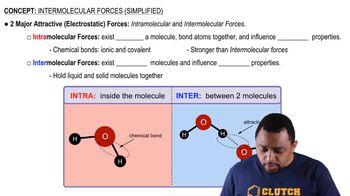
Intermolecular Forces
Intermolecular forces are the attractive forces that occur between molecules. These forces include hydrogen bonding, dipole-dipole interactions, and London dispersion forces. They play a crucial role in determining the physical properties of substances, such as boiling and melting points, especially in molecular crystals where these forces dictate how molecules are arranged and interact.
추천 영상:
가이드 코스
Intermolecular vs Intramolecular Forces
Molecular Crystals
Molecular crystals are solid structures formed by molecules held together primarily by intermolecular forces rather than ionic or covalent bonds. These crystals typically have lower melting points compared to ionic or metallic crystals due to the weaker nature of the intermolecular forces. Understanding the arrangement and types of molecules in these crystals is essential for predicting their properties and behaviors.
추천 영상:
가이드 코스
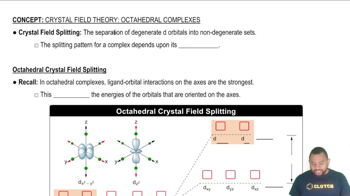
The crystal field splitting pattern for octahedral complexes has the d orbitals on or along the axes as having the higher energy.
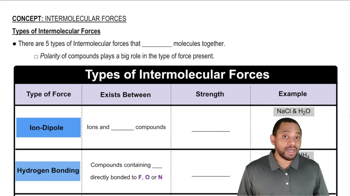
Types of Attractive Forces
The types of attractive forces in molecular crystals include hydrogen bonds, which are strong interactions between molecules containing hydrogen bonded to electronegative atoms; dipole-dipole interactions, which occur between polar molecules; and London dispersion forces, which are weak attractions due to temporary dipoles in nonpolar molecules. Each type of force contributes differently to the stability and characteristics of the crystal structure.
추천 영상:
가이드 코스
Types of Intermolecular Forces
관련 실천
교과서 질문
354
views
교과서 질문
Which type (or types) of crystalline solid is characterized by each of the following? (a) High mobility of electrons throughout the solid;
1063
views
교과서 질문
Which type (or types) of crystalline solid is characterized by each of the following? (b) softness, relatively low melting point;
781
views
교과서 질문
Silicon is the fundamental component of integrated circuits. Si has the same structure as diamond. (b) Silicon readily reacts to form silicon dioxide, SiO2, which is quite hard and is insoluble in water. Is SiO2 most likely a molecular, metallic, ionic, or covalent-network solid?
930
views
교과서 질문
What kinds of attractive forces exist between particles (atoms, molecules, or ions) in (d) and metallic crystals?
520
views