What is the minimum number of atoms that could be contained in the unit cell of an element with a face-centered cubic lattice? (a) 1, (b) 2, (c) 3, (d) 4, (e) 5.
Ch.12 - Solids and Modern Materials
12장, 문제 27
What is the minimum number of atoms that could be contained in the unit cell of an element with a body-centered cubic lattice? (a) 1, (b) 2, (c) 3, (d) 4, (e) 5.
검증된 단계별 안내1
Step 1: Understand the structure of a body-centered cubic (BCC) lattice. In a BCC lattice, atoms are located at each corner of the cube and one atom is at the center of the cube.
Step 2: Calculate the contribution of corner atoms to the unit cell. Each corner atom is shared by eight adjacent unit cells, so each corner atom contributes 1/8 of an atom to the unit cell.
Step 3: Determine the total contribution of the corner atoms. Since there are 8 corners in a cube, the total contribution from the corner atoms is 8 * (1/8) = 1 atom.
Step 4: Consider the atom at the center of the cube. This atom is not shared with any other unit cell, so it contributes fully to the unit cell.
Step 5: Add the contributions from the corner atoms and the center atom. The total number of atoms in a BCC unit cell is 1 (from corners) + 1 (from center) = 2 atoms.
주요 개념
질문에 올바르게 답하기 위해 반드시 이해해야 하는 핵심 개념들은 다음과 같습니다.
Unit Cell
A unit cell is the smallest repeating unit in a crystal lattice that reflects the symmetry and structure of the entire crystal. It defines the arrangement of atoms in the crystal and can vary in shape and size. Understanding the unit cell is crucial for determining the properties of the material, including its density and packing efficiency.
추천 영상:
가이드 코스
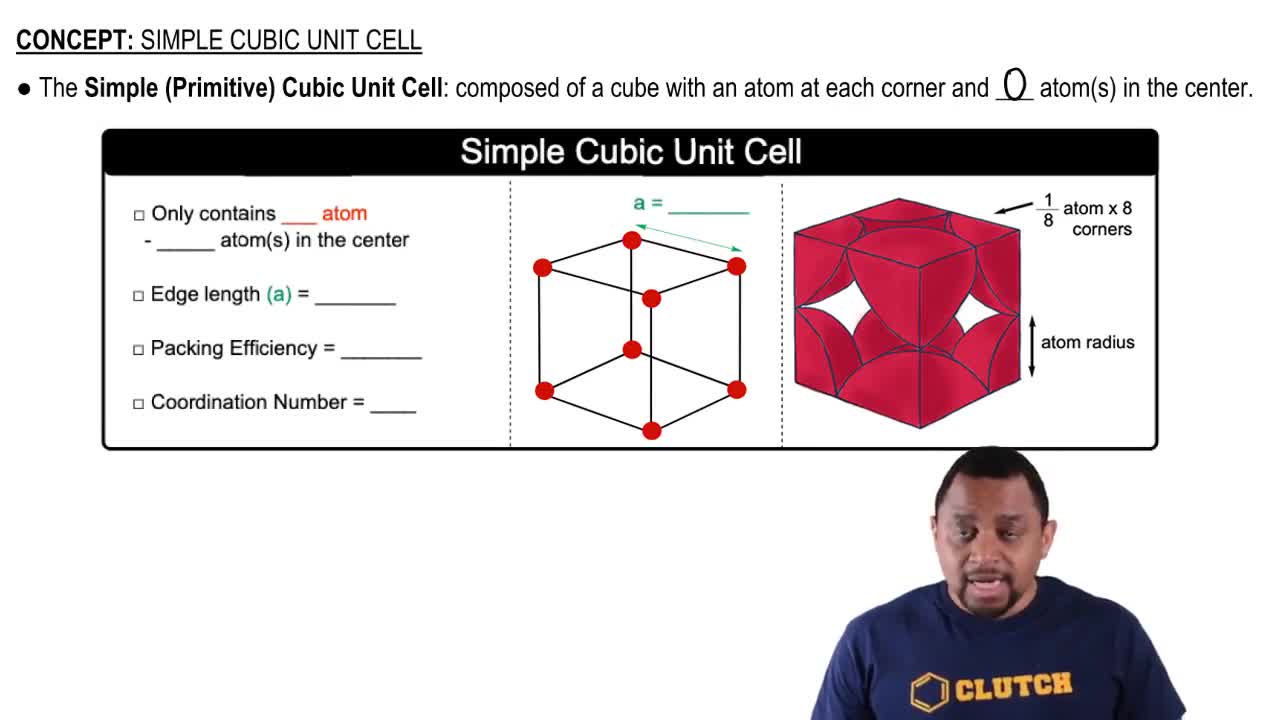
Simple Cubic Unit Cell
Body-Centered Cubic (BCC) Lattice
A body-centered cubic lattice is a type of crystal structure where atoms are located at each corner of a cube and one atom is positioned at the center of the cube. This arrangement results in a specific coordination number and packing efficiency, which influences the physical properties of the material. In a BCC structure, the minimum number of atoms per unit cell is essential for calculating density and other characteristics.
추천 영상:
가이드 코스
Body Centered Cubic Example
Atomic Contribution in Unit Cells
The atomic contribution in unit cells refers to how many atoms effectively belong to a single unit cell based on their positions. In a BCC lattice, each corner atom contributes 1/8 of an atom to the unit cell, and the center atom contributes a full atom. This concept is vital for determining the total number of atoms in the unit cell and solving related problems in crystallography.
추천 영상:
가이드 코스
Simple Cubic Unit Cell
관련 실천
교과서 질문
686
views
교과서 질문
Imagine the primitive cubic lattice. Now imagine grabbing the top of it and stretching it straight up. All angles remain 90. What kind of primitive lattice have you made?
424
views
교과서 질문
Which of the three-dimensional primitive lattices has a unit cell where none of the internal angles is 90? (a) Orthorhombic, (b) hexagonal, (c) rhombohedral, (d) triclinic, (e) both rhombohedral and triclinic.
405
views
교과서 질문
The unit cell of nickel arsenide is shown here. (b) What is the empirical formula?
784
views
교과서 질문
The unit cell of a compound containing potassium, aluminum, and fluorine is shown here. (a) What type of lattice does this crystal possess (all three lattice vectors are mutually perpendicular)?
531
views