
Ch.13 - Properties of Solutions
Brown - Chemistry: The Central Science 14th Edition
Brown14th EditionChemistry: The Central ScienceISBN: 9780134414232당신이 사용하는 게 아니라요?교과서 변경
13장, 문제 54a

Describe how you would prepare each of the following aqueous solutions: (a) 1.50 L of 0.110 M 1NH422SO4 solution, starting with solid 1NH422SO4;

검증된 단계별 안내
1
insert step 1> Calculate the number of moles of (NH_4)_2SO_4 needed using the formula: \( \text{moles} = \text{molarity} \times \text{volume} \). Here, the molarity is 0.110 M and the volume is 1.50 L.
insert step 2> Determine the molar mass of (NH_4)_2SO_4 by adding the atomic masses of all the atoms in the formula: 2(N) + 8(H) + 1(S) + 4(O).
insert step 3> Convert the moles of (NH_4)_2SO_4 to grams using the formula: \( \text{mass} = \text{moles} \times \text{molar mass} \).
insert step 4> Weigh the calculated mass of solid (NH_4)_2SO_4 using a balance.
insert step 5> Dissolve the weighed (NH_4)_2SO_4 in a small amount of distilled water, then transfer the solution to a 1.50 L volumetric flask and fill it with distilled water up to the mark to ensure the final volume is 1.50 L.

비슷한 문제에 대한 검증된 영상 답변:

이 영상 해법은 위 문제에 도움이 된다고 튜터들이 추천한 것입니다.
영상 길이:
1m

주요 개념

질문에 올바르게 답하기 위해 반드시 이해해야 하는 핵심 개념들은 다음과 같습니다.

Molarity (M)

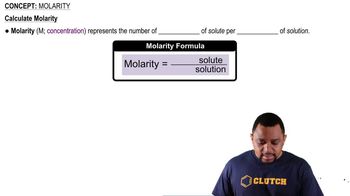
Molarity is a measure of concentration defined as the number of moles of solute per liter of solution. It is expressed in moles per liter (mol/L) and is crucial for preparing solutions accurately. To prepare a solution of a specific molarity, one must calculate the amount of solute needed based on the desired volume and concentration.
추천 영상:
가이드 코스
00:53
Molarity Concept

Stoichiometry

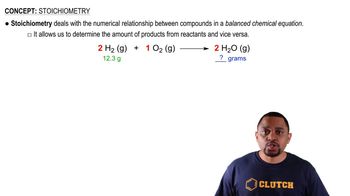
Stoichiometry involves the calculation of reactants and products in chemical reactions. In the context of preparing solutions, it helps determine the mass of the solute required to achieve a specific molarity. Understanding stoichiometric relationships is essential for accurately measuring and mixing chemicals to create desired concentrations.
추천 영상:
가이드 코스
01:16
Stoichiometry Concept

Dissolution Process

The dissolution process refers to how a solute interacts with a solvent to form a solution. When solid ammonium sulfate (1NH4)2SO4 is added to water, it dissociates into its constituent ions, which then become evenly distributed throughout the solvent. This process is important to understand to ensure complete solvation and uniform concentration in the final solution.
추천 영상:
가이드 코스
04:20
Spontaneity of Processes