
Ch.14 - Chemical Kinetics
Brown - Chemistry: The Central Science 14th Edition
Brown14th EditionChemistry: The Central ScienceISBN: 9780134414232당신이 사용하는 게 아니라요?교과서 변경
14장, 문제 51

(c) Which factor is most sensitive to changes in temperature—the frequency of collisions, the orientation factor, or the fraction of molecules with energy greater than the activation energy?

검증된 단계별 안내
1
Understand the three factors involved in the rate of a chemical reaction: the frequency of collisions, the orientation factor, and the fraction of molecules with energy greater than the activation energy.
The frequency of collisions refers to how often molecules collide with each other. This is generally influenced by concentration and temperature, but it is not the most sensitive to temperature changes.
The orientation factor, also known as the steric factor, relates to the spatial arrangement of molecules during collisions. While important, it is typically less sensitive to temperature changes compared to other factors.
The fraction of molecules with energy greater than the activation energy is described by the Arrhenius equation. This factor is highly sensitive to temperature changes because even a small increase in temperature can significantly increase the number of molecules that have enough energy to overcome the activation energy barrier.
Conclude that the fraction of molecules with energy greater than the activation energy is the most sensitive factor to changes in temperature, as it exponentially increases with temperature according to the Arrhenius equation.

주요 개념

질문에 올바르게 답하기 위해 반드시 이해해야 하는 핵심 개념들은 다음과 같습니다.

Collision Theory

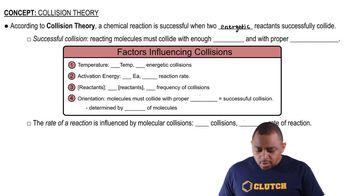
Collision theory explains how chemical reactions occur and why reaction rates differ for various reactions. It posits that for a reaction to take place, reactant molecules must collide with sufficient energy and proper orientation. The frequency of these collisions is influenced by temperature, as higher temperatures increase molecular motion, leading to more frequent and energetic collisions.
추천 영상:
가이드 코스
02:08
Collision Theory

Activation Energy

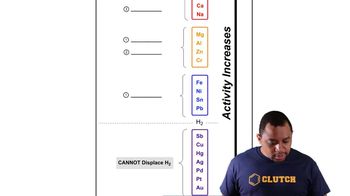
Activation energy is the minimum energy required for a chemical reaction to occur. It represents the energy barrier that must be overcome for reactants to transform into products. As temperature increases, a greater fraction of molecules possess energy exceeding this threshold, which significantly affects the reaction rate and is a key factor in determining how sensitive a reaction is to temperature changes.
추천 영상:
가이드 코스
02:02
Activity Series Chart

Arrhenius Equation

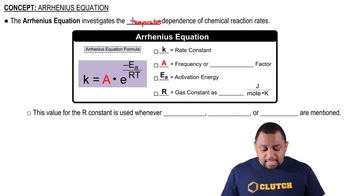
The Arrhenius equation quantitatively describes how the rate constant of a reaction depends on temperature and activation energy. It shows that as temperature increases, the rate constant increases exponentially due to a higher fraction of molecules having sufficient energy to overcome the activation energy barrier. This relationship highlights the sensitivity of reaction rates to temperature changes, particularly through the fraction of molecules with adequate energy.
추천 영상:
가이드 코스
01:20
Arrhenius Equation