
Ch.14 - Chemical Kinetics
Brown - Chemistry: The Central Science 14th Edition
Brown14th EditionChemistry: The Central ScienceISBN: 9780134414232당신이 사용하는 게 아니라요?교과서 변경
14장, 문제 98

The reaction H₂O₂(aq) → H₂O(l) + 1/2 O₂(g) is first order. At 300 K, the rate constant equals 7.0 * 10⁻⁴ s⁻¹. If the activation energy for this reaction is 75 kJ/mol, at what temperature would the reaction rate be doubled?

검증된 단계별 안내
1
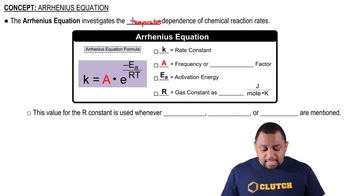
Step 1: Understand the relationship between temperature and reaction rate. The Arrhenius equation, k = A * e^(-Ea/(RT)), describes how the rate constant k depends on temperature T, where A is the pre-exponential factor, Ea is the activation energy, R is the gas constant, and T is the temperature in Kelvin.
Step 2: Use the Arrhenius equation to express the rate constant at two different temperatures. Let k1 be the rate constant at the initial temperature T1 (300 K), and k2 be the rate constant at the new temperature T2, where the reaction rate is doubled (k2 = 2 * k1).
Step 3: Set up the equation for the two rate constants using the Arrhenius equation: k1 = A * e^(-Ea/(R * T1)) and k2 = A * e^(-Ea/(R * T2)). Since k2 = 2 * k1, you can write: 2 * A * e^(-Ea/(R * T1)) = A * e^(-Ea/(R * T2)).
Step 4: Simplify the equation by canceling out the pre-exponential factor A and taking the natural logarithm of both sides to solve for T2: ln(2) = Ea/R * (1/T1 - 1/T2).
Step 5: Rearrange the equation to solve for the new temperature T2: 1/T2 = 1/T1 - (R/Ea) * ln(2). Substitute the known values (Ea = 75,000 J/mol, R = 8.314 J/(mol*K), T1 = 300 K) to find T2.

주요 개념

질문에 올바르게 답하기 위해 반드시 이해해야 하는 핵심 개념들은 다음과 같습니다.

First-Order Reactions

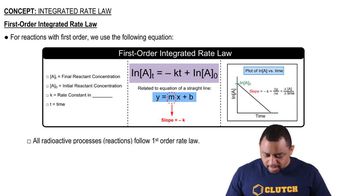
First-order reactions are those where the rate of reaction is directly proportional to the concentration of one reactant. This means that if the concentration of the reactant is doubled, the rate of reaction also doubles. The rate law for a first-order reaction can be expressed as rate = k[A], where k is the rate constant and [A] is the concentration of the reactant.
추천 영상:
가이드 코스
02:29
First-Order Reactions

Arrhenius Equation

The Arrhenius equation describes how the rate constant (k) of a reaction depends on temperature (T) and activation energy (Ea). It is given by k = A * e^(-Ea/RT), where A is the pre-exponential factor, R is the universal gas constant, and T is the temperature in Kelvin. This equation helps predict how changes in temperature affect reaction rates.
추천 영상:
가이드 코스
01:20
Arrhenius Equation

Doubling the Reaction Rate

To double the reaction rate, one must understand the relationship between the rate constant and temperature. According to the Arrhenius equation, increasing the temperature increases the rate constant, thereby increasing the reaction rate. The specific temperature required to achieve a doubled rate can be calculated by determining the new rate constant that corresponds to twice the original rate and solving for the temperature using the Arrhenius equation.
추천 영상:
가이드 코스
02:03
Average Rate of Reaction