Ch.14 - Chemical Kinetics
Brown - Chemistry: The Central Science 14th Edition
Brown14th EditionChemistry: The Central ScienceISBN: 9780134414232당신이 사용하는 게 아니라요?교과서 변경
14장, 문제 69c

(c) Which step is the fastest?

검증된 단계별 안내
1
1. To determine which step is the fastest in a reaction, you need to look at the rate-determining step (RDS) or slowest step. This is because the overall rate of a reaction is determined by its slowest step, similar to how the speed of a convoy is determined by its slowest vehicle.
2. The fastest step in a reaction is the one that is not the rate-determining step. In a multi-step reaction, this would be any step that occurs after the rate-determining step.
3. The rate-determining step is usually given in the problem or can be determined by looking at the rate law of the reaction. The rate law tells us the relationship between the rate of the reaction and the concentrations of the reactants. The order of the reactants in the rate law corresponds to the coefficients of the reactants in the rate-determining step.
4. Once you have identified the rate-determining step, any step that is not the rate-determining step is faster. If there are multiple steps that are not the rate-determining step, it may not be possible to determine which of these steps is the fastest without additional information.
5. Remember, the fastest step in a reaction is the one that has the least energy barrier to overcome, as it can proceed more quickly towards the formation of products.

비슷한 문제에 대한 검증된 영상 답변:

이 영상 해법은 위 문제에 도움이 된다고 튜터들이 추천한 것입니다.
영상 길이:
1m
도움이 되었나요?

주요 개념

질문에 올바르게 답하기 위해 반드시 이해해야 하는 핵심 개념들은 다음과 같습니다.

Reaction Rate

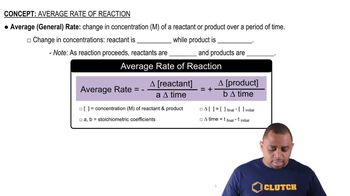
The reaction rate refers to the speed at which reactants are converted into products in a chemical reaction. It is influenced by various factors, including concentration, temperature, and the presence of catalysts. Understanding reaction rates is crucial for determining which step in a multi-step reaction mechanism is the fastest.
추천 영상:
가이드 코스
02:03
Average Rate of Reaction

Rate-Determining Step

The rate-determining step is the slowest step in a reaction mechanism that dictates the overall rate of the reaction. Identifying this step is essential for understanding the kinetics of the reaction, as it often involves the highest energy transition state and thus takes the longest time to occur compared to other steps.
추천 영상:
가이드 코스
01:15
Rate Law Determination

Transition State Theory

Transition state theory posits that during a chemical reaction, reactants pass through a high-energy transition state before forming products. This theory helps explain the energy barriers that must be overcome for a reaction to proceed, and it is fundamental in analyzing which step in a reaction mechanism is the fastest based on the energy profiles of the involved steps.
추천 영상:
가이드 코스
03:12
Transition Metals