
Based on the following reaction profile, how many intermediates are formed in the reaction A¡C? How many transition states are there? Which step, A¡B or B¡C, is the faster? For the reaction A¡C, is ΔE positive, negative, or zero? [Section 14.6]
Ch.14 - Chemical Kinetics
14장, 문제 16
Draw a graph showing the reaction pathway for an overall exothermic reaction with two intermediates that are produced at different rates. On your graph, indicate the reactants, products, intermediates, transition states, and activation energies. [Sections 14.6 and 14.7]
검증된 단계별 안내1
Step 1: Begin by drawing the x-axis and y-axis on your graph. The x-axis will represent the reaction coordinate, which is the progress of the reaction from reactants to products. The y-axis will represent the potential energy of the system.
Step 2: Plot the starting point of the graph at a higher energy level to represent the reactants. Label this point as 'Reactants'.
Step 3: Draw a curve that rises to a peak, representing the first transition state. This peak is the activation energy for the first step of the reaction. Label this peak as 'Transition State 1'.
Step 4: After the first transition state, the curve should drop to a lower energy level than the reactants, indicating the formation of the first intermediate. Label this point as 'Intermediate 1'.
Step 5: Repeat the process for the second intermediate and transition state. Draw another curve rising to a second peak (Transition State 2) and then dropping to a lower energy level than Intermediate 1, indicating the formation of the second intermediate. Finally, the curve should drop further to the lowest energy level, representing the products. Label this final point as 'Products'.
주요 개념
질문에 올바르게 답하기 위해 반드시 이해해야 하는 핵심 개념들은 다음과 같습니다.
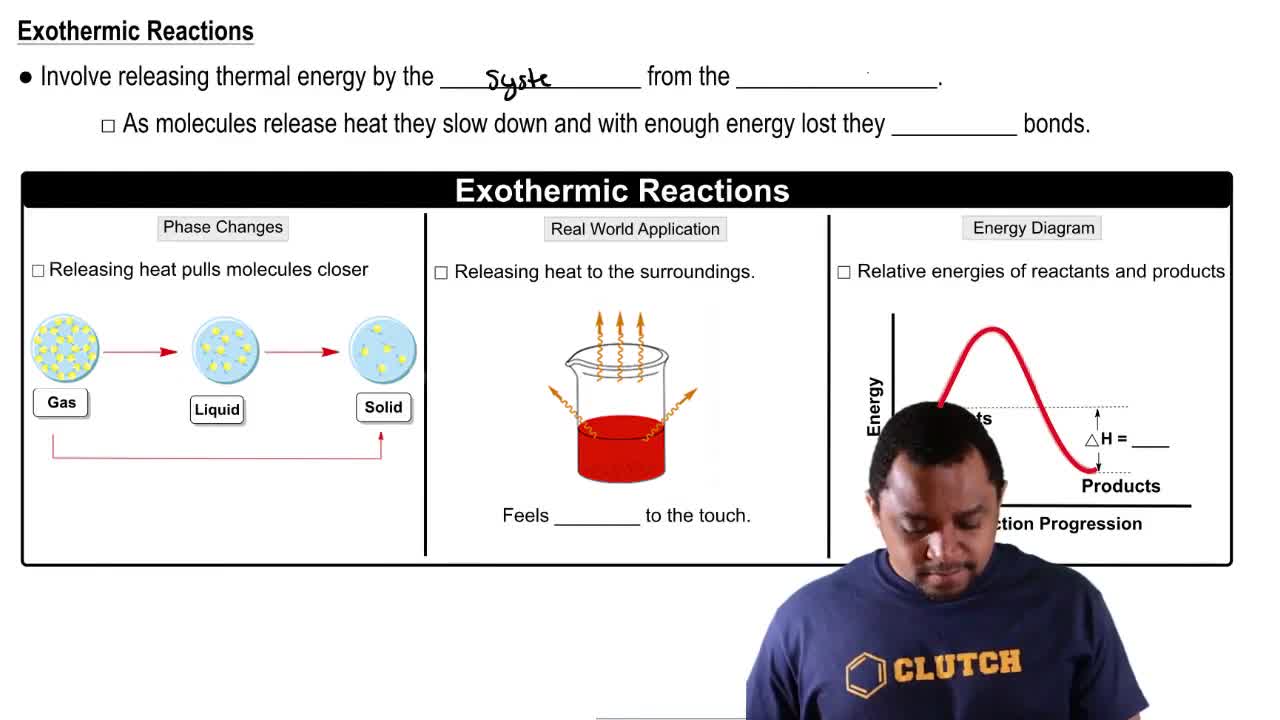
Exothermic Reactions
Exothermic reactions are chemical processes that release energy, usually in the form of heat, to the surroundings. This occurs when the total energy of the products is lower than that of the reactants, resulting in a negative change in enthalpy (ΔH < 0). Understanding this concept is crucial for interpreting the energy changes depicted in reaction pathway graphs.
추천 영상:
가이드 코스
Endothermic & Exothermic Reactions
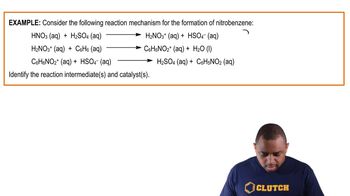
Reaction Intermediates
Reaction intermediates are transient species formed during the conversion of reactants to products. They exist for a limited time and are not present in the final products. In the context of the question, recognizing the role of intermediates is essential for accurately representing their formation and decay on the reaction pathway graph.
추천 영상:
가이드 코스
Reaction Mechanism Example
Activation Energy and Transition States
Activation energy is the minimum energy required for a reaction to occur, which corresponds to the energy barrier that must be overcome to reach the transition state. The transition state is a high-energy configuration of atoms that occurs during the transformation from reactants to products. Understanding these concepts is vital for illustrating the energy profile of the reaction, including the heights of the activation energy barriers associated with each step.
추천 영상:
가이드 코스
Activity Series Chart
관련 실천
교과서 질문
1039
views
3
rank
교과서 질문
The following graph shows two different reaction pathways for the same overall reaction at the same temperature. Is each of the following statements true or false? (b) For both paths, the rate of the reverse reaction is slower than the rate of the forward reaction.
1157
views
교과서 질문
(b) Name three factors that can affect the rate of a chemical reaction.
587
views
교과서 질문
Consider the diagram that follows, which represents two steps in an overall reaction. The red spheres are oxygen, the blue ones nitrogen, and the green ones fluorine. (d) Write the rate law for the overall reaction if the first step is the slow, rate-determining step. [Section 14.6]
462
views
교과서 질문
(a) What are the units usually used to express the rates of reactions occurring in solution?
1033
views
