
Ch.14 - Chemical Kinetics
Brown - Chemistry: The Central Science 14th Edition
Brown14th EditionChemistry: The Central ScienceISBN: 9780134414232당신이 사용하는 게 아니라요?교과서 변경
14장, 문제 13

Based on the following reaction profile, how many intermediates are formed in the reaction A¡C? How many transition states are there? Which step, A¡B or B¡C, is the faster? For the reaction A¡C, is ΔE positive, negative, or zero? [Section 14.6]
Energy diagram showing potential energy vs. reaction progress with points X, Y, Z indicating states.

검증된 단계별 안내
1
Identify the intermediates: Intermediates are species that are formed during the reaction but are not present in the final products. In the reaction profile, intermediates correspond to valleys between peaks. Count the number of valleys.
Identify the transition states: Transition states are the highest energy points along the reaction path, corresponding to the peaks in the reaction profile. Count the number of peaks.
Compare the activation energies: The step with the lower activation energy (the energy difference between the reactant and the peak) is the faster step. Compare the heights of the peaks for A→B and B→C.
Determine the overall energy change (ΔE): Compare the potential energy of the reactants (A) and the products (C). If the energy of C is lower than A, ΔE is negative. If higher, ΔE is positive. If they are the same, ΔE is zero.
Summarize the findings: State the number of intermediates, the number of transition states, which step is faster, and whether ΔE is positive, negative, or zero.

비슷한 문제에 대한 검증된 영상 답변:

이 영상 해법은 위 문제에 도움이 된다고 튜터들이 추천한 것입니다.
영상 길이:
2m
도움이 되었나요?

주요 개념

질문에 올바르게 답하기 위해 반드시 이해해야 하는 핵심 개념들은 다음과 같습니다.

Reaction Intermediates

Reaction intermediates are species that are formed during the conversion of reactants to products but are not present in the final products. In the energy diagram, intermediates correspond to the local minima in potential energy, such as points X and Z in the provided diagram. Identifying intermediates is crucial for understanding the mechanism of the reaction.
추천 영상:
가이드 코스
02:14
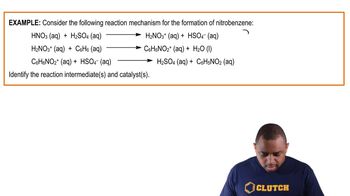
Reaction Mechanism Example

Transition States

Transition states are high-energy states that occur during the transformation of reactants to products. They represent the maximum energy point along the reaction pathway, depicted as the peaks in the energy diagram, such as point Y. Transition states are critical for determining the activation energy and the rate of the reaction.
추천 영상:
가이드 코스
03:12
Transition Metals

Activation Energy and Reaction Rate

Activation energy is the minimum energy required for a reaction to occur, influencing the rate of the reaction. The step with the higher activation energy is typically slower. By comparing the energy differences between the reactants and the transition states for steps A→B and B→C, one can determine which step is faster and whether the overall reaction has a positive, negative, or zero change in energy (ΔE).
추천 영상:
가이드 코스
02:03
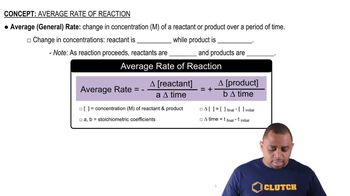
Average Rate of Reaction